What damages a buried sewer pipe
Most repair calls trace back to one of four causes, and the camera shows which before anything gets dug.
Tree roots
Roots slip into joints and hairline cracks looking for moisture, then grow into a mat that catches paper and grease. A line that clogs again a few weeks after cabling often has roots inside it.
Bellied pipe
A sag in the grade holds a pool of waste, so solids settle there and the same clog keeps returning.
Cracked or offset joints
Joints can separate or crack, and soil then washes into the pipe. The gap also lets roots in.
Collapsed section
A crushed or caved-in pipe blocks flow entirely. A cable stops at the same spot every time.
When sewage comes up in the lowest drain
The lowest opening in the house shows a blocked main first. That means a floor drain, a basement or ground-level shower, or the tub on the lowest floor. If only one fixture backs up, the clog is probably local and drain cleaning fits. If several gurgle or overflow together, the main line is blocked.
Stop using every fixture, because each flush or load of laundry adds more water to a pipe that cannot take it. Avoid chemical drain cleaners. They sit in a full pipe, do little, and splash onto whoever opens it next. Sewage carries bacteria, so wear gloves and boots and wash well afterward.
After heavy rain, ask a neighbor whether their drains are acting up too. If they are, call Jenks Public Works at 918-299-5883, since the city maintains the sewer system and the blockage may be in the public main.
Spot dig repair for a localized break
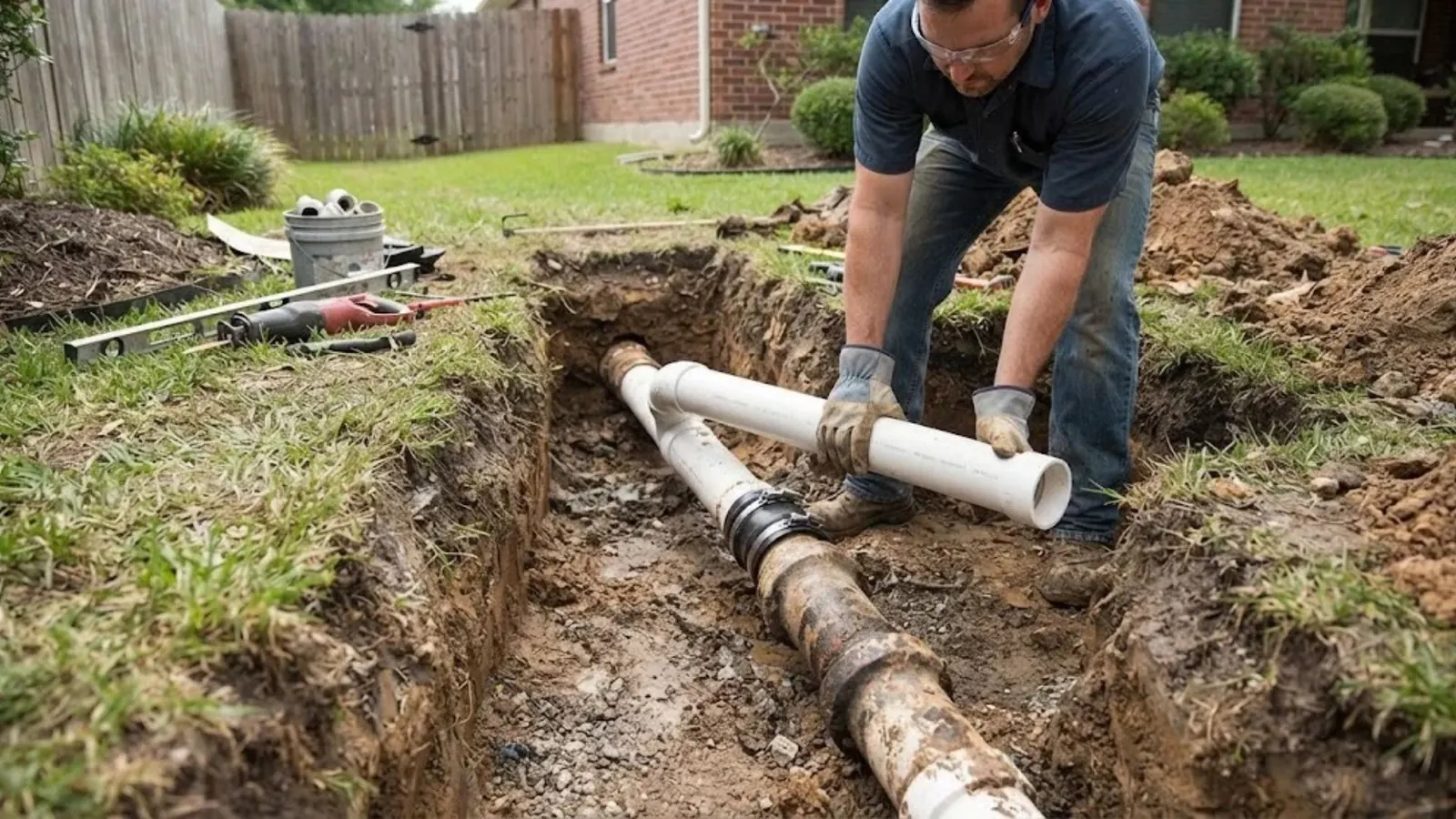
A spot dig opens the ground over one failed section only. The plumber locates it with the camera and a locator, excavates, cuts out the bad length, and joins new PVC with couplings. The trench is bedded and backfilled, and the line is tested.
This suits one cracked joint, one root-damaged length, or a short collapse. The trade-off is the yard. You get a trench, and a driveway or sidewalk in the path will need to be cut. A spot repair assumes the rest of the pipe is sound.
Trenchless pipe lining and pipe bursting
Trenchless repair works through small access holes instead of a long trench. In pipe lining, a resin-soaked liner is pulled through the old pipe, inflated, and cured until it hardens into a new pipe inside the old one. Epoxy lining under a slab uses the same idea and avoids breaking up the floor.
Pipe bursting pulls a bursting head through the old line and drags new plastic pipe in behind it. It can replace a lateral that lining cannot save. Lining needs a continuous, mostly round pipe and shrinks the bore slightly. Bursting needs entry and exit pits and care around other utilities. Neither fixes a deep belly well.
Full sewer line replacement
Full replacement means opening the trench along the whole run and laying new pipe at a correct slope. It is the answer when the pipe is crushed, bellied in several places, or failing at many joints. New pipe on a proper grade also ends the repeat clogs that a sag causes. Jenks Building Inspections handles permits under the 2018 International Plumbing Code (IPC), so ask them which inspection a new pipe run will need.
It is the most disruptive and slowest option, with the biggest restoration job on lawn, landscaping and hardscape. Oklahoma law, Title 59 section 1015, requires a plumbing permit for most plumbing work with leak repairs excepted, so ask the plumber how permitting is handled on yours.
Trenchless or open trench: how to decide
Trenchless (lining or bursting)
- Small holes, so the lawn, driveway and slab mostly stay intact
- Works under concrete, trees and landscaping
- Needs a pipe that is not collapsed for lining
- Does not correct a sag in the grade
- Lining adds a thin wall inside the old pipe
Open trench (spot or full)
- Fixes belly, collapse and offset joints directly
- Visible, inspectable new pipe at a correct slope
- Spot repair is the smallest dig for one failure
- Cuts through lawn, beds and sometimes concrete
- Takes longer and needs surface restoration
When cleaning is enough and when it is not
Sewer drain cleaning and main sewer cleaning clear a blockage. A cable machine cuts through roots, and hydro jetting scours grease and scale off the wall. If the line then runs fine for months, you had a clog. If it backs up again within weeks, a sewer camera inspection should be next, because something in the pipe is catching waste.
Is your Jenks property on a septic system
Jenks properties inside the city are served by city sewer, and Jenks Public Works maintains that system. Some outlying properties may be on septic instead. A septic tank and drain field work differently, so slow drains and gurgling there can point to a full tank or a failing field rather than a broken pipe.
The dispatcher confirms on the call which kind of system you have and what the visit can address. If you are unsure, a round tank lid in the yard is a sign of septic. Calls from Bixby and other nearby towns reach the same dispatcher, who asks the same question.
What a sewer repair visit looks like
Call and triage
The dispatcher asks which drains are affected and whether sewage is on the floor, then sends a licensed plumber.
Camera run
A small camera on a flexible cable goes in through a cleanout or the toilet flange. It shows roots, cracks, offsets, bellies and collapse on screen.
Locate the break
A locator reads the camera head from above ground. That gives depth and position so the dig, if any, is as small as possible.
Price and method
You get a clear price for the recommended method before work starts, along with the alternative and why.
Repair and test
After the repair, flow is tested and the camera is run again where possible. Surface restoration is discussed before the first shovel.
Ask the city which part of the line is yours
Do not assume where the homeowner's responsibility ends. Call Jenks Public Works at 918-299-5883 and ask which part is the homeowner's before you approve a dig near the street.
Census ACS data puts the median Jenks home at 2006, so many lines are newer plastic pipe, where failures more often start at a joint or a settled trench. In the older pockets near downtown, the camera may show clay or cast iron instead.
What affects a sewer repair price
Sewer work is priced by what the camera finds, not by a flat number. You get a clear price before work starts.
Sudden sewage backup is often covered only if you added a water backup endorsement, and root or wear damage is commonly excluded. Policies differ, so read yours and photograph everything before cleanup.
What to do before the plumber arrives
Stop all water
No flushing, laundry, dishwasher or showers until the line is cleared.
Keep people clear
Close off the wet room. Sewage carries bacteria, so keep kids, pets and bare feet away.
Document the damage
Take photos of the water line and affected items for your insurance claim.
Find the cleanout
Look for a capped pipe near the foundation. Do not open it while sewage is backed up, since it can spill.
Sewer repair questions from Jenks homeowners
Yes. The line is open 24/7 and same-day appointments are offered when available. For sewage already on the floor, call right away, then stop all water use until the plumber arrives.
If a cable clears it and it stays clear, it was a clog. If it returns within weeks, or the cable stops at the same spot, the pipe is likely damaged and a camera should confirm.
Often yes. Pipe bursting replaces a lateral through small pits, and lining rehabilitates it if the pipe is still intact. Collapsed or heavily bellied sections may need an open trench.
It can be, when the camera shows the pipe is continuous. The liner is pulled in through a cleanout, so the floor stays intact. A collapsed section under the slab is a different job.
A broken drain line under the house or in the yard shows as wet soil, a sunken spot, a sewage smell or a backup. A camera finds the break, and the repair is a spot dig or a trenchless fix.
No. Cutting roots clears the line, but they regrow through the same gap. Lasting relief means repairing or lining the joint they entered.
That is the city's rule to state. Call Jenks Public Works at 918-299-5883 and ask which part of the line is the homeowner's.
Call the 24/7 line for a camera and a clear price. Call (855) 575-2890