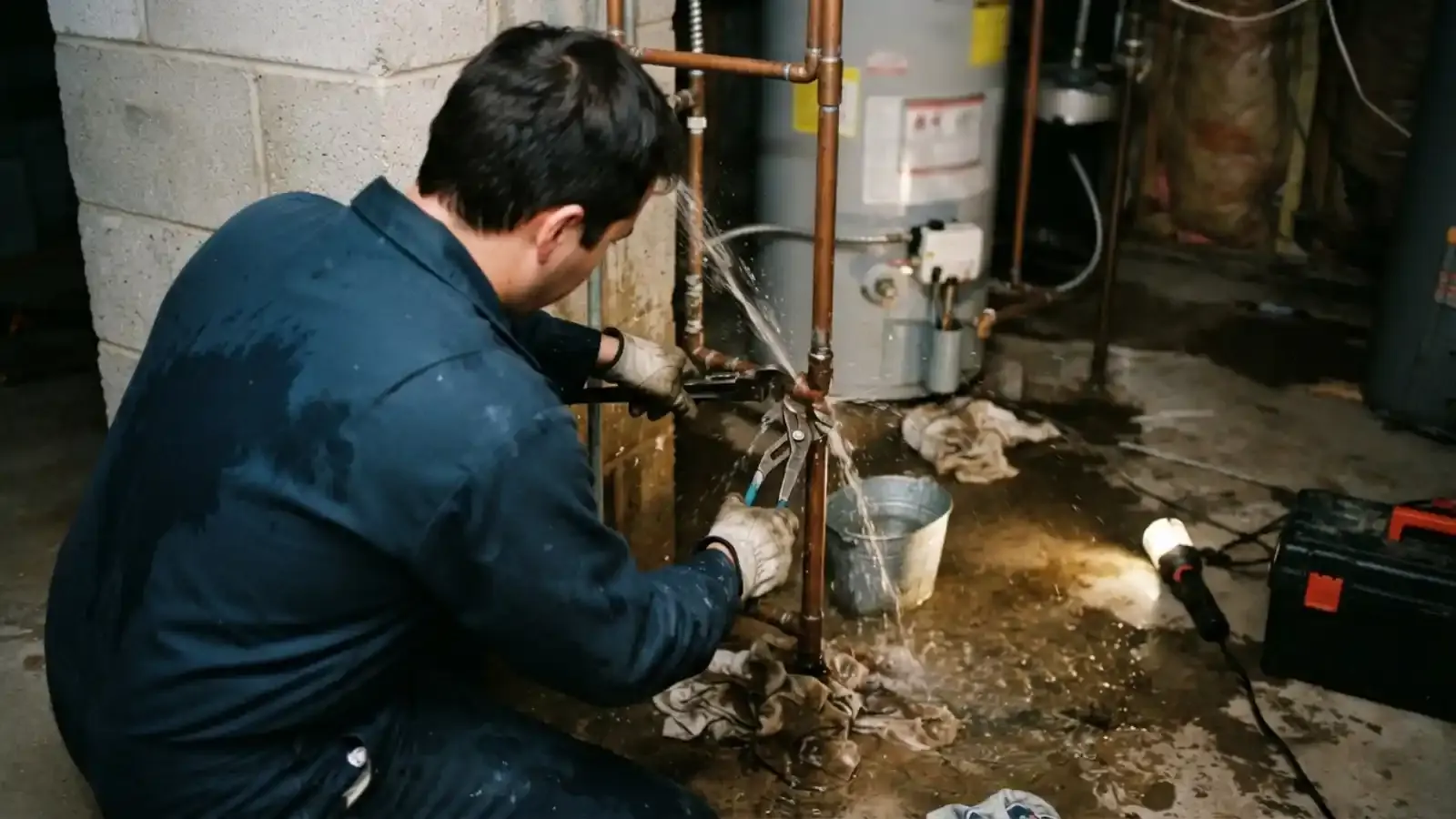
When a burst pipe cannot wait
A burst pipe is any supply or drain line that has split, cracked or blown a fitting open and is leaking more than a drip. If you can see water spraying, pooling or coming through a ceiling, close the main valve at once. The repair itself is a cut-and-replace job: the damaged length is removed, a new section is joined in with proper fittings, and the line is pressure tested.
Not every wet spot is a burst. A pinhole in copper or a loose joint is a smaller leak, and a hidden loss behind a wall may need leak detection before anyone cuts. A split with water actively moving is the one that needs a plumber tonight.
How a burst pipe shows itself
These are the signs that the pipe has failed, not just a fixture.
- Water you can see. A spray, a steady stream or a puddle spreading across a floor from a wall, ceiling or cabinet.
- No water at the taps. Pressure drops to nothing or a trickle because the supply is escaping elsewhere, or a main valve has failed.
- Noise in the walls. Hissing, banging or running-water sounds with every fixture closed.
- A ceiling that sags or bubbles. Water is pooling above the drywall, and the drywall may be close to dropping.
- Brown or cloudy water. Sudden discoloration after a freeze or pressure surge can mean a pipe has shifted or cracked.
What kind of break is it, and what happens next
The pipe material and the type of break decide the repair.
| Situation | Typical fix | Call tonight? |
|---|---|---|
| Split or burst supply line, water spraying | Shut main, cut out section, replace | Yes |
| Frozen pipe, not yet split | Thaw safely, insulate, inspect | Yes, if no flow at all |
| Cracked drain pipe, wet floor or slow drain | Replace the cracked length, test | Yes, if sewage is out |
| Pinhole in copper, slow spray | Repair or replace the section | Same day |
| Failed water valve, no water | Replace valve or isolate branch | Same day |
| Wet wall, source unknown | Locate first, then repair | Yes if water is spreading |
What a repair visit involves
Most burst pipe visits follow the same order.
Stop the water and assess
The plumber confirms the main is off, drains the line and finds the failed section. Wet drywall or flooring is checked so you know how much to open.
Cut out the damaged pipe
A pipe cutter removes the split length with a few inches of margin on each side, so the new joint sits on sound pipe.
Join in new pipe
Copper is soldered or joined with press fittings, PEX uses crimp or expansion fittings, and CPVC uses solvent cement. Drain pipe is replaced with matching PVC or cast iron couplings.
Pressure test
The line is brought back to normal pressure and watched for any drop. A test that holds lets the plumber close the wall.
Walk through the damage
You get a straight list of what dried, what must be replaced and what to tell your insurer.
Shut it off before the plumber arrives
These steps limit damage and are safe for most homeowners.
Find and close the main
The main shut-off is usually where the water line enters the house, in a utility area, garage or near the water heater. Turn it clockwise until it stops. If it will not turn, do not force it, and tell the dispatcher.
Open a low faucet
With the main closed, open the lowest tap in the house to drain the lines and stop residual flow.
Kill power near the water
Switch off the breaker for any room where water touches outlets, fixtures or appliances. If you must wade through water to reach the panel, call the 24/7 line instead.
Thaw only with safe heat
For a frozen pipe, use a hair dryer on low or warm towels from the faucet toward the frozen part. Never use an open flame, torch or heat gun, because pipes, insulation and framing can ignite.
What affects the cost of a burst pipe repair
Pricing depends on the pipe, the access and the damage. You get a clear price before work starts.
Policies differ, so read yours. Sudden burst pipe water damage is often covered, while a failed pipe from long wear or neglect may not be. Photograph everything and keep the failed pipe section if you can.
Freeze and thaw: why pipes split in this region
NWS Tulsa 1991-2020 normals put the January average low at 28.0 F, with about 72 days a year at or below 32 F. That matters because water expands as it freezes, and the split usually shows after the thaw, when pressure returns. Pipes along exterior walls, in garages and in unheated crawl spaces are the first to fail.
Cold also hits public lines. The Jenks freeze-thaw main break on January 8, 2014 cut water to more than half the city for hours, according to news coverage. In a cold snap, drip a tap, open cabinet doors under sinks on exterior walls and know where your main valve is before you need it.
Copper pipe repair
Copper splits along the seam when ice forms, and it also develops pinholes from corrosion. A short split is cut out and sleeved with new copper using solder or a press fitting. If the copper has pitted along a long run, replacing the run is more honest than patching every pinhole.
Cracked drain pipes
A cracked drain line shows as a wet floor under a fixture, a smell or a slow drain. The cracked length is cut out and replaced with matching pipe. A sewer-side crack is a different job that starts with a camera, covered under sewer line repair.
Pipe replacement instead of repair
When a pipe has failed twice, the better call is replacing the section or the line. If whole-house plumbing is the issue, the repiping page covers what that involves.
Temporary clamp or full section replacement
Some repairs are a fix for tonight and some are meant to last.
Clamp or sleeve
- Fast way to stop a small split or pinhole
- Useful to stop damage until parts arrive
- Leaves the original pipe in place
- Not ideal for a long cracked section
- May be a temporary step only
Cut-out and replace
- Removes the damaged length completely
- Restores normal pressure rating
- Takes longer and opens more wall
- Better for repeated or long failures
- Matches the pipe to what is already there
The plumber explains which one fits your pipe and why, and you choose before the work starts. Service also covers Bixby and the other nearby towns.
Burst pipe questions from Jenks homeowners
Yes. The 24/7 line is open at night and on weekends, and a licensed plumber is dispatched when available. Close the main while you wait.
Close the main water valve, switch off power to wet areas if it is safe, and open a low faucet to drain the lines. Then call the 24/7 line.
You can use a hair dryer or warm towels working from the faucet toward the frozen part. Never use a torch or open flame, and call a plumber if you cannot find the frozen spot.
It can be a closed or failed valve, a frozen line or a break upstream. The plumber checks the main, the meter valve and the branch before deciding.
Both. A short split is cut out and replaced, and a long run in poor condition may be better replaced entirely.
Policies differ, but sudden burst water damage is often covered while wear is not. Call your insurer, photograph the damage and keep the failed section.
Describe the break, get the plan, and hear the price first. Call (855) 575-2890