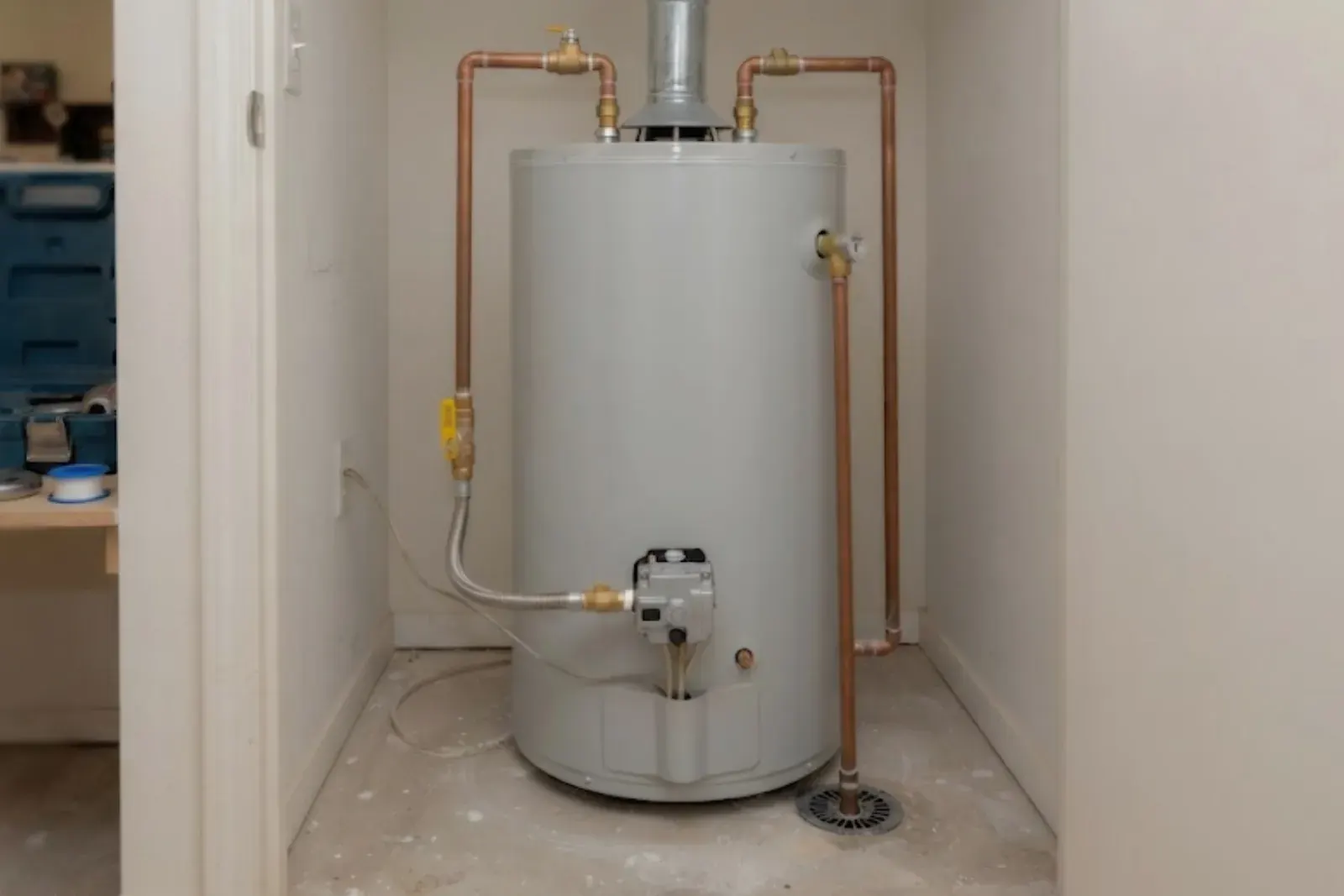
When a leaking tank means a new water heater
If water is seeping from the body or seams of the tank, the steel liner has rusted through and the heater needs to be replaced. No sealant or fitting repair fixes a failed tank, and the leak only gets worse as the metal keeps corroding.
Water heater replacement means draining and removing the old unit, setting a new tank or tankless heater, and reconnecting water, fuel, vent and safety parts to current practice. In Jenks, many homes were built after 2006 according to Census ACS data, so a heater that is leaking now is often an original unit at the end of its ten to fifteen year life rather than a freak failure.
Turn off the water first. Every hour a tank leaks, it dumps more water into flooring, drywall and the framing underneath.
When a burst or leaking heater cannot wait
Any one of these usually points toward replacement rather than repair.
- Water at the base. Seeping from the bottom or the seam, not from a pipe fitting above.
- Rust-brown hot water. A sign the tank interior is corroding and shedding rust.
- Age past twelve years. The data plate lists the serial number and build date, and the plumber can decode it.
- Constant sediment noise. Heavy rumbling after flushing means thick scale has baked onto the bottom.
- Repeat repair bills. A second major part in one year often costs more than a new unit over time.
- A flooded utility room. After a basement or garage flood, the burner, controls and electrical parts are suspect even if the tank looks fine.
Choosing a tank size for your household
Capacity depends on how many people shower in the same morning window. These are typical sizes, and the plumber confirms the right one when looking at your usage and the space.
| Household | Typical tank | What to weigh |
|---|---|---|
| 1 to 2 people | 30 to 40 gallons | Fits a closet, but runs short with a soaking tub |
| 3 to 4 people | 40 to 50 gallons | The common size for a family house |
| 5 or more people | 50 to 75 gallons | Big showers and laundry overlap |
| Large soaking tub or two baths in use | Higher recovery, or a second unit | Recovery rate matters more than tank size |
| Tight closet or attic | Whatever fits the pan and clearances | Height and vent route decide it |
Bigger is not always better, since a larger tank holds more standby heat.
Gas versus electric usually follows what the house already has. Gas heats back up faster and needs a vent and a gas connection, while electric needs no flue and a dedicated circuit sized to the heater. Switching fuel is possible but costs more because of the gas line or wiring involved.
What a replacement visit looks like
Most tank swaps take a few hours when the space is accessible.
Shut off and drain
The plumber closes the water and gas or power, then drains the old tank through the drain valve and a hose to a floor drain or outside.
Disconnect and haul away
Water lines, gas line or electrical, vent and relief pipe come off. The old heater is carried out and hauled away, so you are not left with a 100 pound tank in the garage.
Set the pan and the new tank
A drain pan with a pipe to a safe spot goes under the heater. New flex connectors and dielectric fittings make the water connections.
Vent, relief and expansion tank
A gas heater needs a vent that slopes and draws correctly. A new temperature and pressure relief valve with a discharge pipe goes on, and an expansion tank is added where the system calls for one.
Fill, test and fire up
The tank is filled and purged of air, gas fittings are leak tested, and the burner or elements are tested before the plumber walks you through the controls.
While you wait for the plumber
A few quick steps will protect your home and speed up the swap.
Stop the water
Turn the cold supply valve clockwise. If it is stuck, close the main at the meter.
Remove the power or gas
Flip the breaker off for electric. Turn the gas control to off, and if you smell gas, leave and call the gas utility or 911.
Clear a path
Move stored items away from the heater and from the route to the door. The plumber needs room to bring the new tank in.
Photograph the setup
Take a picture of the vent, pan, gas valve and data plate before anything is removed. It helps with insurance and with sizing.
What goes into a replacement price
The plumber gives you a clear price before work starts, and it is built from the points below.
If the heater burst and damaged floors or walls, ask your insurer whether sudden water damage is covered, though the heater itself usually is not, and policies differ.
Standard tank or heat pump water heater
Most homes in Jenks keep a standard tank, but a heat pump water heater is an option if you are open to a different setup. This is not a claim about rebates, and any program is something to check with your electric utility.
Standard gas or electric tank
- Lower upfront cost for most homes
- Fits the existing venting, gas line or wiring
- Quick recovery on gas models
- Familiar service and parts
Heat pump water heater
- Uses electricity to move heat, so energy use is much lower than a resistance element
- Needs air space around it and a drain for condensate
- Cooler, damper air from the unit can matter in a closet
- Switching from gas means a new electric circuit and no gas vent
If you want to compare heat pump or tankless options for a planned upgrade, the water heater installation page covers the planning side, and tankless service covers on-demand units. The same service covers Glenpool and the other nearby towns.
Replacement questions from Jenks homeowners
Yes. The line is open 24/7 for burst tanks, flooded closets and gas-related heater problems. A licensed plumber is dispatched, and same-day replacement is available when stock and schedules allow.
Not always. Leaks from a fitting, drain valve or relief valve are repairable, but water from the tank body or seams means replacement. The plumber traces the source before recommending anything.
Most households of three or four use a 40 to 50 gallon tank. The plumber checks how many people use hot water at once and what fits the space.
Yes, removal and haul-away are part of the visit. The tank is drained, disconnected and carried out.
Shut off the cold supply and power or gas, then call. Move belongings off wet floors and take photos for your insurer. Do not use a heater that sat in standing water.
It can be done. The gas line is capped, an electric circuit is added, and the unit needs space and a condensate drain. The plumber walks through whether your closet or garage suits it.
Often yes, when the home has a closed system with a check valve or pressure regulator, since heated water has nowhere to expand. The plumber checks your setup on site.
Tell dispatch your tank size and fuel type to speed up the visit. Call (855) 575-2890