Hot water runs out or turns lukewarm?
If your hot water fades to lukewarm mid-shower, swings between hot and cold, or never gets hot enough, a tankless unit is usually blocked, starved or mis-set rather than broken. The usual causes are scale on the heat exchanger, a clogged inlet filter, too many fixtures running at once or a failing sensor.
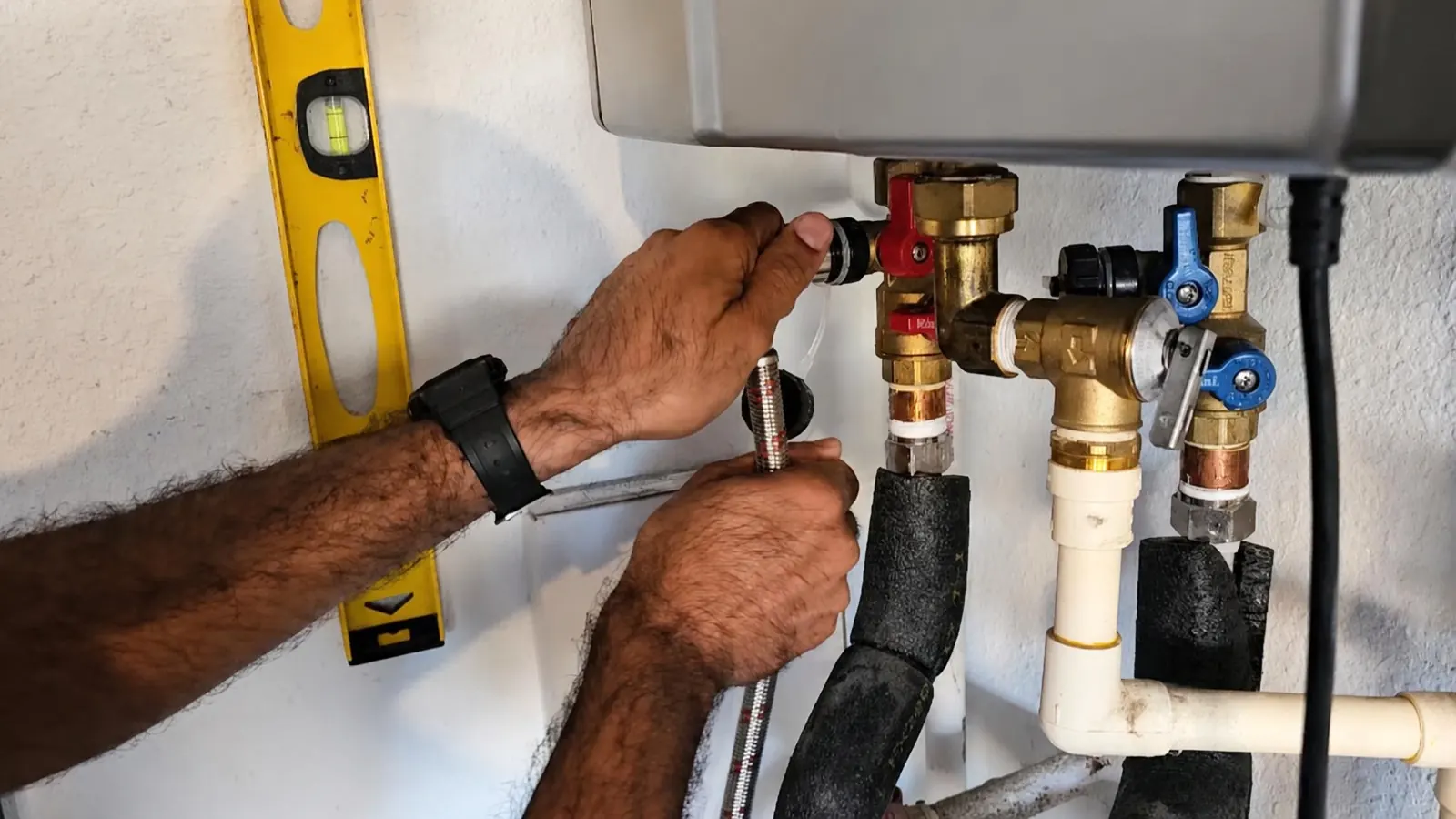
The fix is called tankless descaling and flushing: a plumber circulates a descaling solution through the heat exchanger, rinses it, then cleans the filter and checks the controls. Scale is why this matters in Jenks, and the section below explains it.
Tankless flush and descale: what the visit involves
Most units have isolation valves that make the flush simple. The plumber follows the manufacturer's descaling instructions for your model. Installing or replacing a unit falls under the 2018 International Plumbing Code (IPC), International Fuel Gas Code (IFGC) and International Mechanical Code (IMC) that Jenks adopted, so ask Jenks Building Inspections about a permit.
Read the code and the history
The plumber checks the display for error codes, the flow and temperature settings and the age and model of the unit.
Isolate the heater
Power or gas goes off, the cold and hot isolation valves close, and a small pump and hoses connect to the service ports.
Circulate descaling solution
A food-safe descaler (many manufacturers call for white vinegar) runs through the heat exchanger for the time the instructions call for. This dissolves scale that restricts flow and makes the unit overheat.
Flush and clean the filter
Fresh water rinses the solution out, and the cold water inlet screen is pulled and cleaned of grit.
Test the unit
The valves reopen, air is purged, and the plumber fires the unit and checks temperature rise, flow and any gas or vent connections.
Common tankless problems and what they point to
The symptom narrows the fault before any part is replaced.
| What you notice | Likely cause | Typical fix |
|---|---|---|
| Lukewarm water, display fine | Scale on the heat exchanger | Descale and flush |
| Water runs hot then cold | Low flow or a clogged inlet filter | Clean the filter, check the flow sensor |
| Error code on the display | Ignition, flame, vent or sensor fault | Read the code, test the part it names |
| Not enough hot water for two showers | Unit sized below the demand | Review sizing, flow limits or a second unit |
| No ignition at all | Gas supply, igniter or condensate trap | Check the gas valve, igniter and trap |
| Hot water delay | Long pipe run to the fixture | Consider a recirculation line |
What a tankless water heater is and where it struggles
A tankless water heater is a wall-hung unit that heats water as it passes through a heat exchanger, using a gas burner or electric elements. There is no stored tank, so it never runs out of stored hot water, but it has a flow limit: a gas unit can only raise so many gallons per minute by a set number of degrees.
That limit is why two showers and a dishwasher can overwhelm a unit sized for one bath. Gas models also need a larger gas line and a sealed stainless or plastic vent. Safety comes first with any gas unit, and gas line questions are confirmed on the call.
Hard water is the other issue. The City of Tulsa publishes about 8.2 grains per gallon of hardness for its A.B. Jewell plant, and Jenks buys its water from Tulsa. That does not tell you the exact figure at your tap, which a test kit or a call to the city can confirm.
Even moderately hard water leaves scale in a heat exchanger over time, so a regular flush protects the unit. If you want to reduce scale at the source, see water softener and filtration.
What affects tankless service pricing
The plumber gives you a clear price before work starts.
Normal wear and scale are not usually covered by homeowner insurance, though a sudden water loss may be, and policies differ.
Before you buy or keep a tankless unit
- Count the fixtures. Peak use matters more than household size.
- Check the gas line. Confirm size and length with a plumber before you commit.
- Ask about isolation valves. They make future flushing quick.
- Plan a yearly flush. The schedule depends on water hardness and use.
- Consider a new install. See water heater installation for planning a switch.
- Check service reach. We serve Sapulpa and nearby towns as well.
Tankless questions from Jenks homeowners
Scale on the heat exchanger, a clogged inlet filter or too many fixtures running can all cut the output. A flush and descale clears the first two, and the plumber checks sizing for the third.
Many manufacturers suggest yearly, and harder water may call for more often. Check your manual, and ask the plumber.
The City of Tulsa publishes about 8.2 grains per gallon for its Jewell plant, which supplies Jenks. A test kit or the city can give a number for your tap.
Codes point to ignition, flame, vent, flow or sensor faults. Note the number and call, and the plumber arrives with a likely part.
Some owners do with a pump and hoses if the unit has service valves. A plumber is the safer choice for gas units and for units without valves.
Call the 24/7 line and dispatch will say what is available. Gas smells go to the gas utility or 911 first.
Give dispatch the model and the symptom when you call. Call (855) 575-2890