Spots, scale, dry skin and orange stains: what hard water looks like
These signs usually point to minerals or iron in the water. Treating them is called water softening or filtration, depending on the cause.
Spots on dishes and glass
White film left after the dishwasher runs is typically calcium and magnesium drying on the surface.
Scale on fixtures
Crusty buildup on faucet aerators and showerheads, and chalky rings in a kettle, come from the same minerals.
Dry skin after showers
Many people notice this with hard water, but plenty of things cause it. For skin concerns, ask your physician.
Orange or brown stains
Rust-colored marks in sinks and tubs can mean iron in the water or rust from pipes. A water test tells the two apart.
Weak flow at one faucet
A scaled aerator or cartridge often shows up first at a single fixture.
What Jenks water hardness looks like
Jenks buys its water from the City of Tulsa, treated at the A.B. Jewell plant. The City of Tulsa publishes an average hardness of about 8.2 grains per gallon, or about 140 ppm, for that plant. On the commonly used USGS scale, that falls in the hard band.
The Jenks water quality report does not list hardness, so treat the Tulsa number as a plant average and not your tap. A hardness test kit from a hardware store, or a call to the city, confirms your reading. A hard-water number matters because scale shortens the life of a water heater by coating its heating surfaces and tank bottom.
Salt-based softener versus salt-free conditioner
They solve different problems, so the choice depends on what you want from the water.
Salt-based softener
- Swaps calcium and magnesium for sodium or potassium on a resin bed
- Actually removes hardness minerals from the water
- Needs salt refills and a drain for regeneration
- Sized by household water use and hardness
- Best when you want soft feel and scale-free fixtures
Salt-free conditioner
- Changes how minerals form scale, but does not remove them
- No salt and no regeneration drain
- Little maintenance beyond media replacement
- Results vary, so ask what the product claims
- Best when you want less scale and cannot run a drain
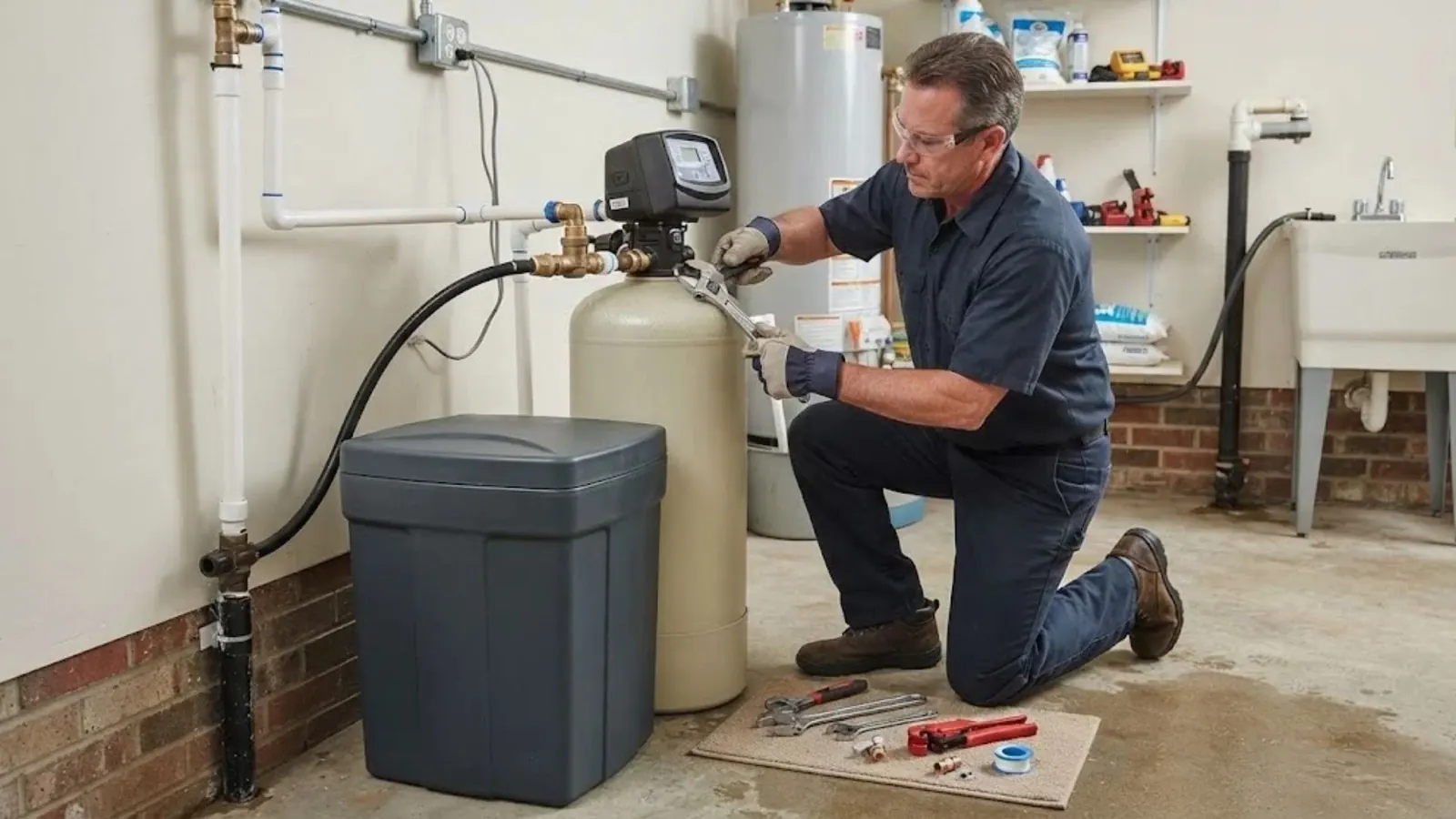
What an installation visit involves
Here is how a typical softener or whole-home filter goes in.
Test and size
The plumber checks hardness and iron, counts people in the home, and sizes the unit. As an example, four people using about 80 gallons each a day at 8.2 grains is roughly 2,600 grains a day, or about 18,000 a week.
Pick the spot
Near the main shutoff, ahead of the water heater, with a power outlet, floor space and a drain nearby. Outdoor spigots are usually left on untreated water.
Plumb it in
Shutoff, bypass valve, new fittings, and a brine line. Regeneration flushes salty water out, so the drain line needs an air gap and a legal drain connection. Ask the city about discharge rules for your property.
Set and test
The plumber sets hardness and regeneration, checks for leaks and shows you how to add salt and use the bypass.
What to do when your softener or conditioner stops working
Hard water returning is the usual sign. A quick check starts with the salt level, a salt bridge in the brine tank, the bypass valve and power to the control head.
Common failures
The control valve can crack or wear, the resin bed can foul with iron, and the brine line can clog. A move or construction can break a valve or cut a drain line.
Repair or replace
Valve replacement typically costs less than a new unit, so it makes sense on a sound tank. If the resin is old and the tank is corroded, replacement usually costs less over time.
Filters, reverse osmosis, UV and what NSF/ANSI labels mean
Filtration targets different things than softening. Sediment filters catch sand and rust flakes. Carbon filters reduce chlorine taste and odor. An under-sink reverse osmosis system filters drinking water through a membrane at one tap. A UV unit treats microorganisms in clear water, and it is usually paired with a sediment filter.
NSF/ANSI standards are how filters get tested. Standard 42 covers aesthetic effects like chlorine taste and odor, 53 covers health-related contaminants, and 58 covers reverse osmosis systems. Read the label to see which contaminants a product is certified to reduce.
We do not diagnose health effects of water, so ask your physician about those questions. If you worry about a specific contaminant, send a sample to a certified lab and choose a filter that targets what the report finds.
What affects water treatment pricing
We give you a price before work starts. Here is what moves it.
Water treatment is typically a household upgrade and not an insurance claim. If a failed unit floods a room, policies differ, so read yours.
Water treatment questions in Jenks
White spots are usually mineral deposits from hard water. A softener, or a rinse aid and cleaner, reduces them. A test kit shows how hard your water is.
The City of Tulsa publishes about 8.2 grains per gallon (about 140 ppm) for the plant that supplies Jenks. Your tap may differ, so confirm with a test kit.
Yes. Salt-based softeners discharge brine during regeneration, so they need a drain with an air gap. Salt-free conditioners do not.
Size depends on people, daily water use and hardness. The plumber calculates grains per week and picks a tank that regenerates at sensible intervals.
Often yes, including valve replacement and brine line problems. Whether it is worth fixing depends on the age of the resin and tank.
We do not make health claims. Send a sample to a lab for contaminants and check NSF/ANSI labels on any filter.
Questions about the water at your tap? Call and ask. Call (855) 575-2890