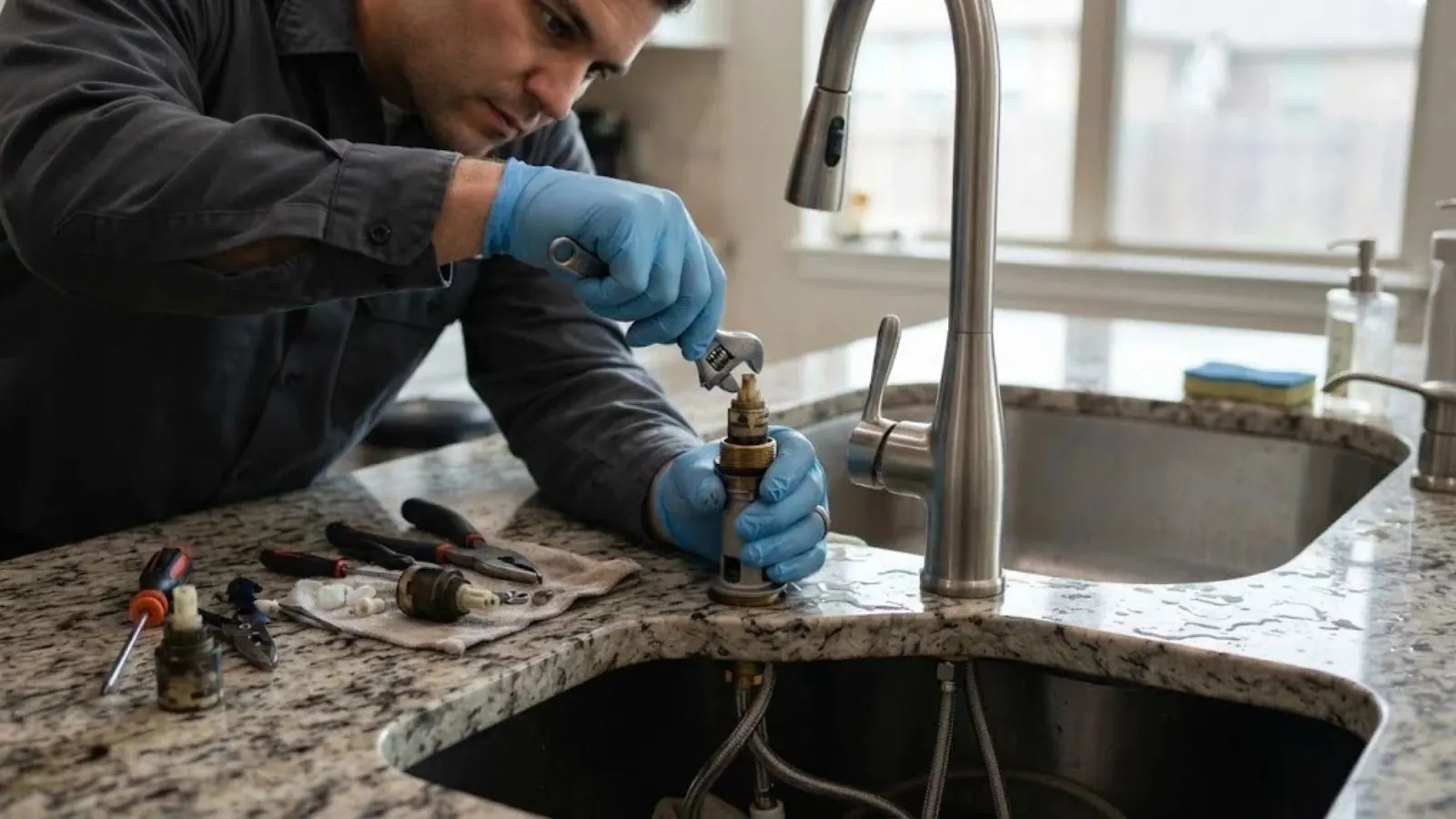
You may fix a faucet yourself, and here is where that ends
Oklahoma statute section 1017 exempts minor repairs, such as faucets and fixture parts, from state plumbing licensing, and state law lets an individual do plumbing work on their own residence. So replacing a cartridge or washer is a legitimate DIY job. If you replace instead of repair, look for the EPA WaterSense label on a new faucet, which marks models that use less water.
DIY ends where the water you cannot shut off begins. A stuck stop valve, a leaking supply line inside a wall, or any repair that needs the main shut off is a call. The same goes if you are not sure which parts you are holding.
Fixing a dripping faucet in the right order
This sequence works for most single-handle and two-handle faucets.
Shut the water
Close both stop valves under the sink. Open the faucet to drain pressure and confirm the water is off.
Plug the drain
A rag in the sink drain keeps small screws from vanishing. Pry the cap off the handle and remove the screw beneath.
Pull the cartridge or stem
Lift the handle and unscrew the retaining nut. Pull out the cartridge, or the stem on a compression faucet.
Match the part
Take the old part to a hardware store. Brand and model matter, since cartridges are rarely interchangeable.
Reassemble and flush
Rebuild in reverse, then remove the aerator and run water to flush debris before reinstalling it.
Faucet type and what usually fails
Knowing your type tells you which part to buy.
| Faucet type | Usual failure | The fix |
|---|---|---|
| Compression, two handles | Worn washer or seat | Replace washer and seat |
| Cartridge, single handle | Worn O-rings or cartridge | Swap the cartridge |
| Ball type | Worn seals and springs | Rebuild kit |
| Ceramic disc | Cracked disc or seals | Replace the disc cartridge |
| Pull-down kitchen | Weak spray, hose leak | Check hose, aerator and weight |
| Any type with low flow | Mineral buildup | Clean the aerator, soak parts |
Hard water leaves scale in aerators and cartridges. Tulsa says its water averages about 8.2 grains per gallon, and Jenks buys its water from Tulsa.
Broken supply valve: stop the water first
The shut-off valves under a sink or behind a washer fail more often than people expect. A valve that has not been turned in years can seize, drip at the stem, or snap when forced. When one breaks, the line is under full pressure, so the main shut-off is the safe move.
If a faucet has to be replaced rather than repaired, look for the EPA WaterSense label on bathroom models, which sets a flow standard of 1.5 gallons per minute. Any faucet that supplies drinking water should also carry NSF/ANSI 61 and 372 marking, which covers the federal lead-free requirement.
Stop valve under the sink
Each fixture has a small valve on its own supply line. Turn it clockwise to close. If it will not move, leaks at the stem or sprays when touched, do not wrench it, since the stem can break loose.
Angle stop
The angle stop is the quarter-turn or multi-turn valve where the line comes out of the wall and turns to the fixture. Old multi-turn stops wear their packing and washers. Replacing one means shutting off the house water, which is why many people call for this one.
Washing machine valve
The two hot and cold valves behind the washer are easy to ignore. A drip at the hose, a stuck handle, or a burst braided hose can flood a laundry room fast. Turn the valves off when you leave for a trip, and replace rubber hoses with braided ones.
Shower, tub and drain trouble
Bathroom fixtures hide their problems behind tile and in the wall, so the symptom matters.
Leaking shower valve or showerhead
A showerhead that drips after shutoff usually has a worn washer or a loose arm connection. A valve that leaks inside the wall, or a stained ceiling below, is not a DIY. Try tightening the head with plumber tape first.
Clogged shower or tub drain
Hair and soap form a plug just below the strainer. A drain tool pulls most of it out. If water backs up in a second fixture or a floor drain, the clog is further down, and drain cleaning is the answer.
Bathtub faucet repair
Tub spouts and the diverter that sends water to the shower wear out together. Water that dribbles from the spout while the shower runs means a failing diverter. Most tub faucets use the same cartridge style as a sink.
General faucet repair
Kitchen and bath faucets share causes: worn seals, mineral scale, loose supply nuts. Spotting which one you have saves guessing.
What to do before the plumber arrives
Do these while you wait.
Close the stop valve
Turn the oval handle under the fixture clockwise. If it will not close, shut the main.
Protect the cabinet
Empty the cabinet under the sink and set a bucket under the leak.
Locate the main
Know where the main water valve sits so you can shut it in seconds.
Photograph the fixture
A photo of the brand name and the damage helps match parts and supports an insurance claim.
How faucet and valve repairs are priced
A cartridge swap and a wall valve replacement differ in cost. You get a clear price before work starts.
Sudden water damage from a burst supply line is often covered, while a worn faucet itself is not. Policies differ, so read yours.
Stop and call a plumber if
- The stop valve will not close. Forcing it can snap the stem.
- Water is spraying or has not stopped. Shut the main and call right away.
- The leak is inside the wall. Stains or sagging drywall mean a hidden line.
- The faucet is part of a new install. See plumbing installation for replacement work.
- You are unsure which part fits. Wrong parts leak again.
Calls from Sapulpa and the other Tulsa County towns we serve reach the same line.
Faucet and fixture questions
Yes. The line is open 24/7, with same-day appointments when available. If water will not stop, close the main and call.
Yes. Oklahoma exempts minor repairs like this from state licensing. Shut the valves, remove the handle and old cartridge, and match the new one by brand and model.
A worn washer, seat or cartridge seal is the usual cause. Over time it also wastes water.
A drip at the stem is usually a packing nut. Water inside the house when the spigot is on points to a failed vacuum breaker or a frozen line.
Check the faucet base, the supply lines, and the drain trap. A drip at the trap often means a loose slip nut.
Yes. Cartridges differ by brand, size and spline count, so bring the old one to the store.
Valve or faucet leaking? Call now. Call (855) 575-2890