A sewer backup is a main line problem until proven otherwise
Every fixture in the house drains into one pipe, and a blockage in that pipe has nowhere to push waste except up. The lowest opening gives way first, which is usually a basement or ground-level floor drain, a tub or a shower.
If only the kitchen sink is slow, the clog is local. If a toilet gurgles when the washer drains, or two bathrooms back up together, the blockage is on the main line.
The City of Jenks Public Works department maintains the city's sewer system. If neighbors are also backing up or you see sewage in the street, call Public Works as well, because the problem may be in the public main.
Where the blockage sits
The pattern of which fixtures back up points to the location.
| What backs up | Likely location | Who clears it |
|---|---|---|
| One sink or tub only | Fixture trap or branch | Drain cleaning visit |
| Lowest drain and toilets together | Main line on your property | Sewer line cleaning |
| Several houses on the street | City sewer main | Jenks Public Works |
| Backup after heavy rain | Main line or stormwater entering the system | Plumber, then city if it persists |
| Backup returning every few months | Roots, bellied pipe or crack | Cleaning plus camera |
Ask the city who owns the lateral where it meets the public main, since that rule varies.
What causes a main line to clog
Most main line clogs trace to a short list of causes.
- Tree roots. Fine roots enter at joints and trap paper until the line fills, which is why backups can recur on a schedule.
- Grease buildup. Kitchen fat cools in the horizontal run and narrows the opening year by year.
- Wipes and hygiene products. Labeled flushable wipes do not break up like paper and snag on any rough joint.
- Bellied or sagging pipe. A low spot holds water and solids that eventually settle into a plug.
- Foreign objects. Toys, rags and kitchen debris wash in through a floor drain or a broken fixture.
How the main line gets cleared
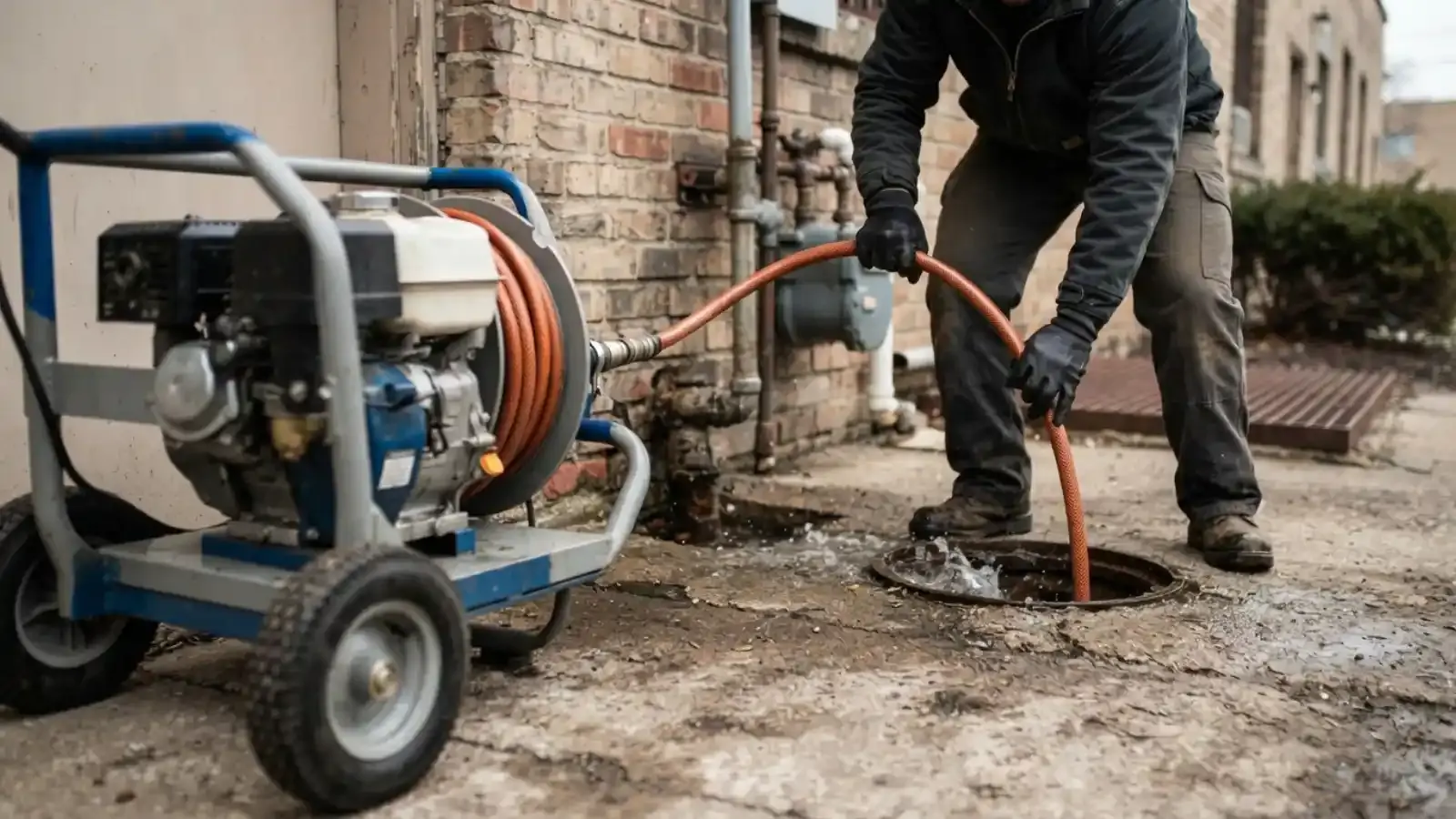
The plumber starts at the cleanout, the capped pipe that gives direct access to the main line without removing a toilet. It is usually outside near the house or in a basement, and a cleanout is the first thing to point out when you call. Plumbing codes generally call for cleanouts at set points on drain lines, and Jenks has adopted the 2018 International Plumbing Code (IPC), so ask the plumber to add one if yours is missing.
Cable first
A heavy cable with a cutting head is fed down the line until it reaches the blockage. For roots, a blade shaves them back inside the pipe. For a grease or paper plug, a spearhead tears through it and the cable pulls debris out.
Jetting when the wall is coated
If the cable opens a path but the pipe wall is lined with grease or scale, high-pressure jetting washes it clean. The method and its limits are on our hydro jetting page.
Camera after the line is open
With flow restored, a camera shows what caused the blockage and whether the pipe is sound. A recording of roots entering a joint or a bellied section tells you whether you need a repair or simply regular cleaning. See sewer camera inspection for what the camera shows.
Repeat clogs and what to do about them
A main line that clogs twice in a year has a cause that cleaning alone will not remove.
Roots
Cleaning buys months, not years. Spot repair or lining closes the entry point.
Grease
Change what goes down the kitchen drain, and schedule jetting if buildup returns.
A belly
Water pooling in a low section cannot be cleaned away. It needs a dig and regrade.
Offset joint
Pieces that no longer line up catch debris. A camera finds it and a repair fixes it.
Cracked pipe
Soil and roots enter the break. Repair is the answer, and jetting through it makes it worse.
What sewer line cleaning costs
The price depends on access and the cause. We quote before work starts, once you describe which drains are backing up.
Policies often exclude cleaning a clogged line, though water damage from a sudden backup may be covered if you have a sewer backup endorsement. Policies differ, so read yours.
What to do if sewage is coming up now
These steps limit damage and keep people safe while you wait for a plumber, day or night.
Stop all water
No flushing, no laundry, no dishwasher, no showers. Water used upstairs ends up in the lowest drain.
Keep clear of the water
Sewage carries bacteria. Keep children and pets away, and wear gloves and boots if you must handle anything.
Clear the way to the cleanout
Leave the cap on unless the plumber asks, since backed-up waste can spill out. Just clear a path to it.
Lift belongings
Move rugs, boxes and electronics off the floor. Turn off power to any wet area if water is near outlets.
Sewer cleaning questions in Jenks
Yes. The line is open 24/7, and a plumber can come the same day or after hours for a backup. Stop water use and call.
A cleanout is a capped pipe giving direct access to the main sewer line. Look near the foundation, along the side of the house, or in a basement or garage floor.
If neighbors are also backing up, the city main is a suspect, so call Jenks Public Works. If only your house is affected, the blockage is likely on your side.
It will if grease or a one-time object caused it. If roots or a damaged pipe caused it, the backup returns until the cause is repaired. A camera shows which.
No. Sewer drain cleaning works on the main line, while drain cleaning works on a fixture or branch.
Yes. We serve Jenks, Glenpool, Bixby, Sapulpa and Kiefer. See the Glenpool page for details.
Sewage backing up? Call now and tell us what is coming up. Call (855) 575-2890