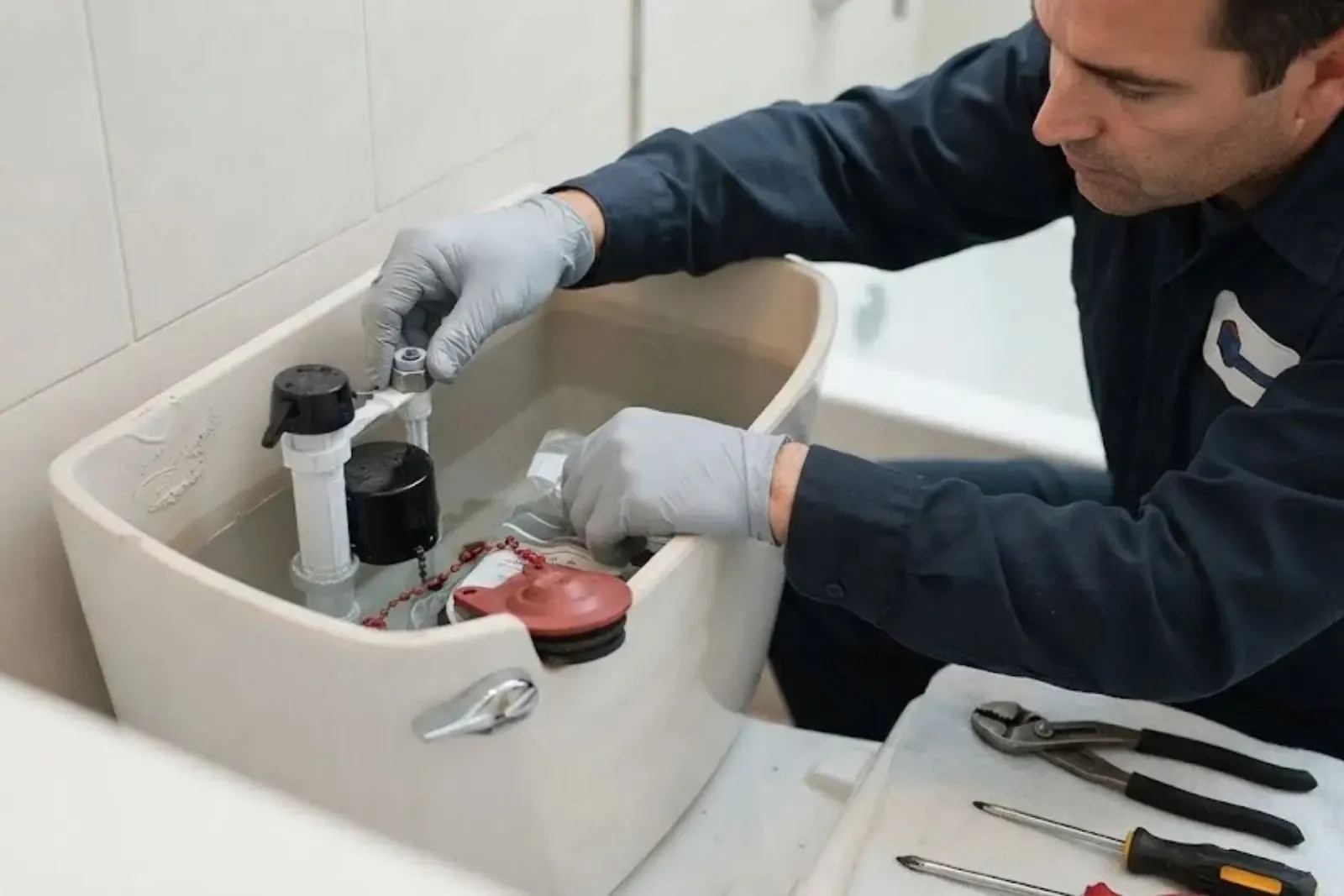
Start with hot water and dish soap
Stop flushing first. Lift the tank lid and push the flapper down so the tank cannot refill and push more water into a full bowl. If the bowl is already near the rim, scoop some out with a cup until it sits about halfway.
Squeeze a generous amount of dish soap into the bowl, about a quarter cup. Heat a bucket of water until it is hot from the tap or a kettle, but not boiling, because boiling water can crack the porcelain. Pour it in from waist height and wait 20 to 30 minutes. The soap lubricates the blockage and the heat softens paper and waste, so the water level often drops on its own.
Check before you try anything stronger
A few quick observations tell you whether this is a simple bowl clog or something deeper.
- Only this toilet is slow. The blockage is likely in the trap just under the bowl, and every method below can reach it.
- The bathtub or sink gurgles when you flush. Air is being pushed back through another fixture, which points to the branch line.
- Water rises in the tub or shower floor drain. The blockage is past the toilet, so stop flushing and skip the bowl methods.
- You flushed wipes, a toy or a pad. These do not break down, so soap and water alone will rarely work.
- Water is at the rim and rising. Close the shutoff valve behind the toilet, a small oval handle near the floor, by turning it clockwise.
What to do: five ways to clear it without a plunger
Work down this list from gentlest to strongest, and rest between attempts.
Hot water and dish soap
Pour the soap, then the hot water, and wait half an hour. A soft paper clog often drains slowly and then all at once.
Wet-dry vacuum
Set the vacuum to liquid, remove the filter, and bail out most of the bowl water first. Seal the hose tight against the drain opening with a towel and run it in short bursts. It can pull a clog up or loosen it from the trap.
Closet auger
This is a short, stiff cable with a curved guide made for toilets, and it will not scratch the porcelain. Seat the guide in the drain, crank the handle clockwise, and push in gently until you feel the blockage. Pull back slowly to bring out whatever is caught.
A bent wire hanger, with caution
A straightened hanger with a small hook can snag a washcloth or toy near the bowl outlet. Wrap the tip in a rag so it does not scratch the glaze, and never force it, because a hanger can leave porcelain marks and push a clog deeper.
Flush test after each try
Pour a bucket of water in quickly from waist height instead of using the handle. If the bowl drains fast, the line is clear. If it rises, stop and move to the next method.
What to try, and what to avoid
Match the method to the clog before you spend an hour on it.
| Situation | Best first move | Avoid |
|---|---|---|
| Too much toilet paper | Hot water and dish soap | Repeated flushing |
| Wipe, pad or paper towel | Closet auger | Chemical drain opener |
| Child's toy in the bowl | Wet-dry vac or gloved hand | Forcing it down with a hanger |
| Slow every time you flush | Check the vent and branch line | Reaching for caustic cleaner |
| Water backing into the tub | Stop and call a plumber | More flushes |
A toilet that clogs repeatedly is a sign of a line or vent problem, not bad luck.
Stop and call when a second method fails, when more than one fixture is slow, or when sewage smell rises from the floor drain. Those signs point to a blocked branch line that needs a cable or hydro jetting, which no household tool reaches.
What never to pour in, and what is safe
Many homeowners reach for a bottle of drain cleaner when a plunger is missing. In a toilet, that is the worst choice. Many toilet manufacturers' instructions warn against chemical openers, and plumbing guidelines generally favor a plunger or auger, since caustic liquid can sit in the bowl and splash when you finally use a tool.
Never use these
- Liquid drain openers with lye or acid, which can sit in a full bowl and splash back at you
- Boiling water, which can crack a cold porcelain bowl
- Bleach mixed with any other cleaner, which releases toxic gas
- Harsh solvents, which can damage the wax ring seal and plastic parts
- Repeated flushes that spill dirty water onto the floor
These are safe to use
- Dish soap, a quarter cup or so
- Hot tap water or a bucket of very hot water
- Baking soda and vinegar only as a mild loosener, not a cure
- Rubber gloves and an old towel around the base
- A closet auger or a wet-dry vacuum
If a chemical opener is already sitting in the bowl, do not use a vacuum or auger until you have called a plumber, because the liquid is hazardous to touch.
Jenks, Oklahoma: where your clog ends up
The City of Jenks says Jenks Public Works maintains the city's sewer, storm drain and water systems, and that the city runs its own wastewater treatment plant. That means a blockage in the public main is the city's problem, but a blockage between your toilet and the main is yours to clear.
Census data shows the median Jenks home was built in 2006, so many toilets here are newer builder-grade models, often low-flow. Low-flow bowls clear less forcefully, which makes them more sensitive to wipes and extra paper. If the whole street backs up at once, call the Public Works line the city publishes, 918-299-5883, and let us handle the drain inside your home.
The same advice holds for our neighbors in Bixby and Glenpool, where newer subdivisions use the same style of low-flow toilet. A licensed plumber can pull the toilet, check the flange and wax ring, and run a cable from the cleanout if the blockage is deeper.
Questions about a clogged toilet
Yes. Hot tap water is safe for porcelain, while boiling water can crack it. Pour it from waist height and give the dish soap time to work.
Wait 20 to 30 minutes after the soap and hot water. If the level has not dropped at all, move to a wet-dry vacuum or closet auger.
It can loosen a light paper clog, but it is weak. It will not clear wipes, toys or a stuck pad, so treat it as a first try only.
When water rises toward the rim, spills onto the floor, or backs into a tub or shower. Close the shutoff valve and call. Our line is open 24/7 and we can often schedule the same day.
The City of Jenks publishes a Public Works number for sewer concerns. If the backup is only in your home, a plumber handling drain cleaning can clear the line.
A toilet that will not clear on your own can reach a plumber any hour. Call (855) 575-2890