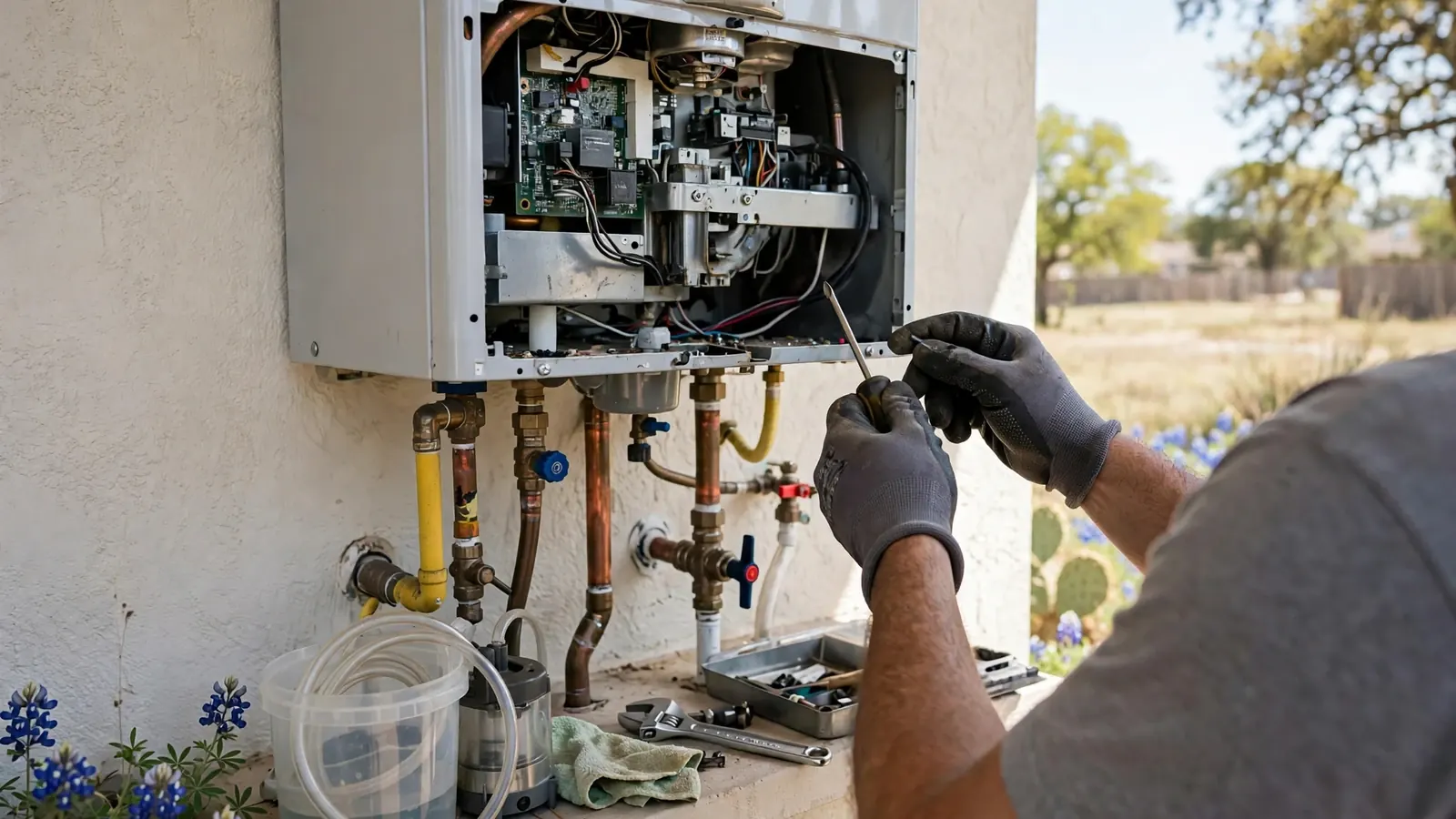
The crawl space question in plain terms
Most manuals list approved locations such as indoors, outdoors, in a garage or in an alcove. A crawl space is often a gray area, since it is cramped, damp and cold. Some models are rated for it and many are not. According to the 2018 International Fuel Gas Code that Jenks adopted, gas appliances go in per the manufacturer's instructions, so a spot the manual does not list can fail inspection.
A crawl space also complicates every later visit. A plumber has to crawl in with a flashlight to flush the unit, and any leak or failed part can go unnoticed for weeks. If your crawl space is the only option, a water heater installation visit can judge access first. Read the manual and ask Jenks Building Inspections what applies before you choose a spot.
Five problems a crawl space creates
Each of these has a fix, but each adds cost or limits the models you can use.
Venting
Condensing gas units use sealed plastic vent pipes out a side wall. Non-condensing units need metal venting. Both need required clearances to windows and vents.
Freeze risk
Built-in freeze protection runs only with power, and it does not protect exposed pipes outside the unit. A crawl space with open vents can drop below freezing.
Condensate
Condensing models make acidic condensate. It needs a neutralizer and a proper drain, and gravity may not help below grade.
Gas line size
A tankless draws much more gas at once than a tank. An older half-inch line often cannot supply it.
Access
Annual descaling needs valves and hoses to be reached. A hard crawl can mean skipped maintenance.
Crawl space versus other locations
If you have options, compare them before drilling any holes.
Crawl space install
- Keeps floor space clear
- Cold and damp, higher freeze risk
- Hard to service and inspect
- Condensate and vent routing are harder
- Only if the model and code allow it
Garage, closet or exterior wall
- Easier to reach for descaling
- Often shorter vent and gas runs
- Freeze risk is easier to manage
- Condensate drains by gravity more often
- Still check clearances and local code
Gas line and venting details
Tankless heaters often draw well over 100,000 BTU per hour at full fire, while a typical tank burner draws far less. Pipe diameter, run length, fittings and the other gas appliances on the same line all enter the sizing. A plumber uses the gas code tables to size it, and the answer is sometimes a larger line from the meter.
Gas line sizing
Do not guess based on the old heater. Add up total BTU of every appliance on the run, measure the pipe length, and size to the code table. If you smell gas at any time, leave the building and call the gas utility or 911 before you call a plumber.
Venting and combustion air
Vent pipe material, length and the number of elbows are limited by the manufacturer. Termination points need clearance to windows, doors and meters. In a crawl space the vent often has to run up through the rim joist, which needs careful sealing against pests and drafts.
If your home is in Sapulpa, where Census data shows more than half of homes were built before 1980, the existing gas piping may be older, so sizing matters even more. A tankless water heater job there often starts with the gas line.
Jenks, Oklahoma: freeze days and code
NWS Tulsa normals for 1991 to 2020 show about 72 days a year at or below 32 degrees, and Tulsa hit minus 3 degrees on Feb. 15, 2021. That is a Tulsa station, not a Jenks gauge, but a vented crawl space can follow that cold. Plan freeze protection for the unit, its power supply, and the pipes around it.
The City of Jenks has adopted the 2018 International Plumbing Code, effective April 2022. Oklahoma state law requires a plumbing permit for work other than leak repairs. Ask Jenks Building Inspections about permits for a new heater, and check the manufacturer manual and local code before you drill or cut.
Freeze protection is not a guarantee
Many electric and gas tankless units include heaters that guard the heat exchanger, but only down to a stated temperature and only while power is on. A power outage during an ice storm leaves the unit unprotected, so insulate supply lines, seal drafty vents and learn the drain-down procedure in your manual.
Power is the weak link. If your crawl space unit has a freeze heater, put it on a circuit that does not share a breaker with anything you might switch off.
Homeowners in Kiefer, about 10 miles south-southwest of Jenks, ask the same questions, and a plumber serving Kiefer can check the space on site.
Before you commit to the crawl space
- Read the manual. Look for a stated approved location list.
- Ask the city. Call Jenks Building Inspections about permits and inspections.
- Check the gas meter. Ask about line size and total appliance load.
- Plan the drain. Work out where acidic condensate can go.
- Test access. Can a plumber reach the front panel and water valves on their back?
Questions about crawl space tankless heaters
Sometimes. Only if the manual lists it as an approved location and local code allows it. Many models are not rated for it.
Condensing gas units do, and the condensate is acidic, so it usually needs a neutralizer. Route it per the manual and local code.
Often not. Tankless units draw far more gas at once, and a licensed plumber should size the line from total load and run length.
Use the unit's built-in protection, keep power on, insulate lines and close off drafty vents. None of these is a guarantee in a long outage.
Not by default, but the vent usually exits through a rim joist or side wall, and Tulsa normals show about 72 days a year at or below 32 degrees, so sealing and insulation matter.
Planning a tankless install? A licensed plumber is on the 24/7 line. Call (855) 575-2890