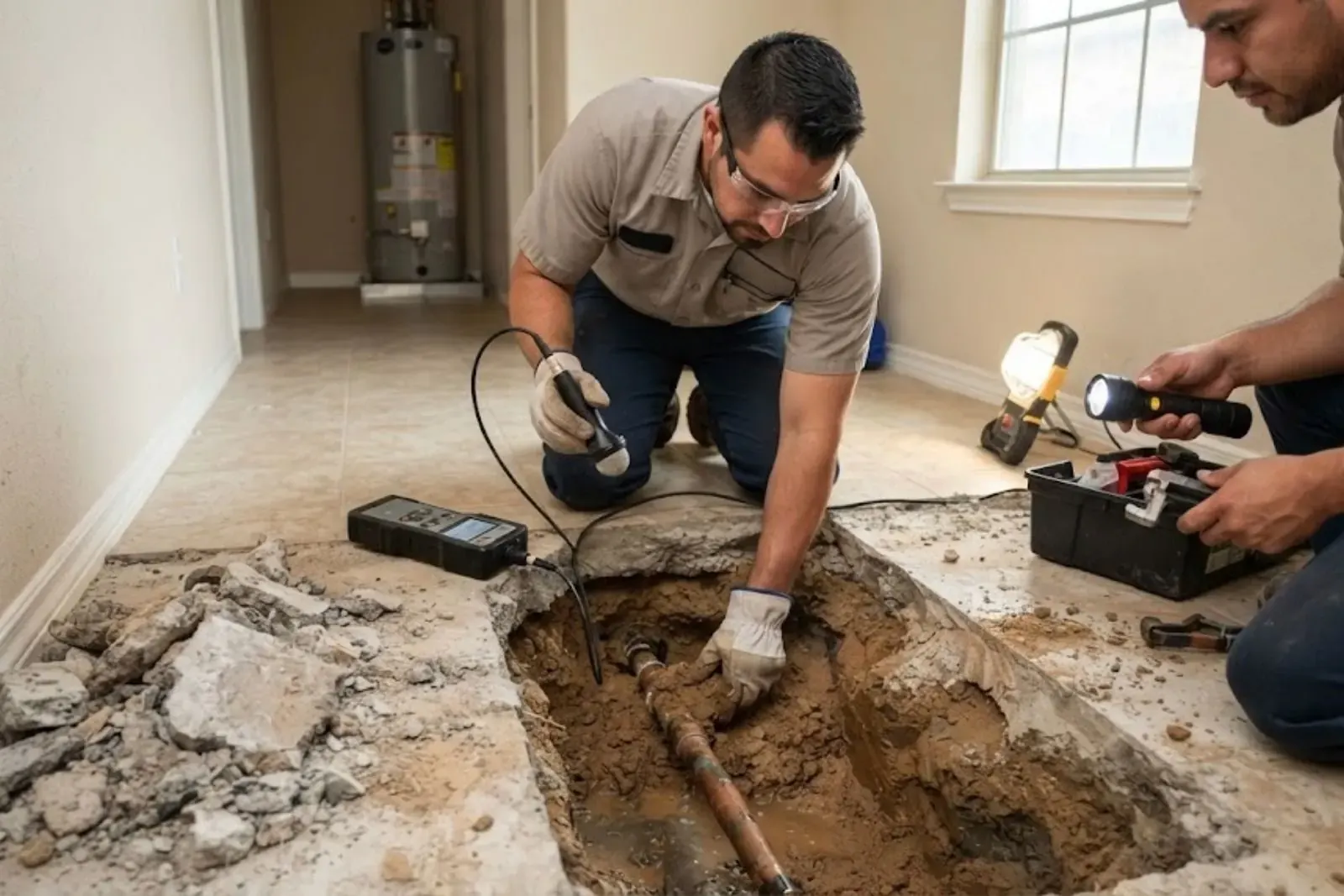
The signs that point under the floor
No single sign proves it. Two or three together are a strong reason to have the line tested.
A warm or hot spot on the floor
A leaking hot-water line under the slab heats the concrete above it. Bare feet find it before any tool does.
A meter that moves with taps off
If every fixture is closed and the meter still runs, water is escaping somewhere on your side of it.
The sound of running water
A hiss or trickle in a quiet house, especially at night, can come from a pressurized line cracking underfoot.
Damp carpet or lifting flooring
Moisture rising through the slab stains carpet backing and makes laminate or tile edges lift.
A sudden jump in the water bill
A leak runs around the clock, so the bill climbs with no change in how your household uses water.
Low pressure or discolored water
Flow can drop at the tap when a line loses water upstream, and silt or mineral taste can follow.
What a slab leak is and why it is hard to spot
Many homes carry water supply lines through or under the concrete slab, and a pinhole or crack in one of those lines can leak for weeks without a visible puddle. The water soaks into soil and slab instead of the room, so the damage tends to show up late.
Slab leaks are not limited to old houses. Pipes can fail from friction against rough concrete, from a manufacturing flaw, from a poor joint, or from corrosion where water chemistry attacks the metal. Whether your home sits on a slab at all matters first, since a crawl space or basement changes where a leak shows up. Check how your home is built before you worry.
The International Plumbing Code (IPC) that Jenks has adopted calls for a pressure-reducing valve when static pressure passes 80 psi, and a cheap gauge on an outdoor hose bib will show where yours sits.
Slab leak, or something else?
Several other problems mimic these signs, so use this to separate them before you spend money.
| What you notice | Slab leak? | Other possibility |
|---|---|---|
| Warm spot on the floor | Likely, hot line | Radiant heat or sun through glass |
| Damp baseboard | Possible | Roof leak, plumbing wall leak, high humidity |
| Meter runs with taps off | Possible | Toilet leak or yard line leak |
| Sound of water in quiet house | Possible | Running toilet, water heater fill |
| High bill only | Weak sign alone | Irrigation, guests, seasonal use |
| Sewer smell and stains | Unlikely | Drain or vent problem |
A plumber's test decides it. Do not break concrete based on one sign.
Jenks, Oklahoma: check how your house is built
Census data shows the median Jenks home was built in 2006, and about 3,300 homes went up between 2010 and 2019. Newer builds often use PEX or copper supply lines, and some are built on slabs with the lines buried in the concrete. If your home is on a slab, that is where to focus. If it has a crawl space, a similar leak shows up as damp insulation instead.
The City of Jenks says its Home Water Usage sheet counts leaks from piping, toilets and fixtures as sources of household use. That means a rising reading on your meter is a prompt to test, not proof of where the water is going.
How plumbers confirm a leak under the slab
A licensed plumber starts with a meter or pressure test to prove water is leaving the system. Then electronic listening gear and thermal imaging help trace where the sound or heat is strongest. This narrows the search to a small patch, which is the aim of professional leak detection.
Pinpointing matters because it decides how much of your floor has to be opened. You do not want guesswork where the other side of the answer is a jackhammer. Oklahoma plumbing license law requires a permit for work other than leak repairs, so a spot repair is exempt while a new overhead reroute may need one, and Jenks Building Inspections can confirm.
The repair itself is covered on our slab leak repair page. In short, the options go by three names: a direct spot repair through the slab, rerouting the line overhead through walls or attic, and lining the damaged pipe from the inside. Which one fits depends on the pipe, the number of leaks and the floor, and a plumber should explain the trade-off before work starts.
What to do while you wait
These steps cost nothing and protect the house, but they do not replace testing.
- Run the meter test. Close every fixture, note the reading, and check again after 30 minutes.
- Mark the warm spot. Use painter's tape on the floor and tell the plumber exactly where it sits.
- Check the water heater. If the warm spot is near the heater, look at its base and relief valve line for a plain tank leak.
- Close the main if damp spreads. Stopping the water costs you a few hours without a tap, which beats flooded flooring.
- Photograph stains and the meter. Dated photos help with any insurance conversation, and policies differ, so read yours.
When it points to a bigger plumbing decision
A single slab leak is a repair. Repeated leaks on the same type of pipe can mean the whole run is failing, and that conversation moves toward repiping the house. If you live in Bixby or Kiefer, the same questions apply: how old is the pipe, and how many leaks has it had.
Meanwhile, you can shut the main to stop the damage and call. Do not wait for the floor to buckle.
Questions about slab leak signs
No. Water lines do not heal, and the leak grows as pressure erodes the hole. Concrete holds the water until it finds a path out.
No. A warm patch can come from heating ducts, sun through a window or a radiant system. A warm spot plus a moving meter is a much stronger signal.
Plumbers use pressure tests, acoustic listening and thermal imaging to narrow the area first, then open only the smallest section.
Policies differ, so read yours. Some cover resulting water damage but not the pipe itself, and a plumber's written findings can help with a claim.
Not every one does. Check your closing paperwork, look for a crawl space door or a basement, or ask the builder. The Jenks Building Inspections office at 918-556-7439 may also be able to point you to records for your address.
Seeing two or more signs? Call and a licensed plumber will talk it through. Call (855) 575-2890