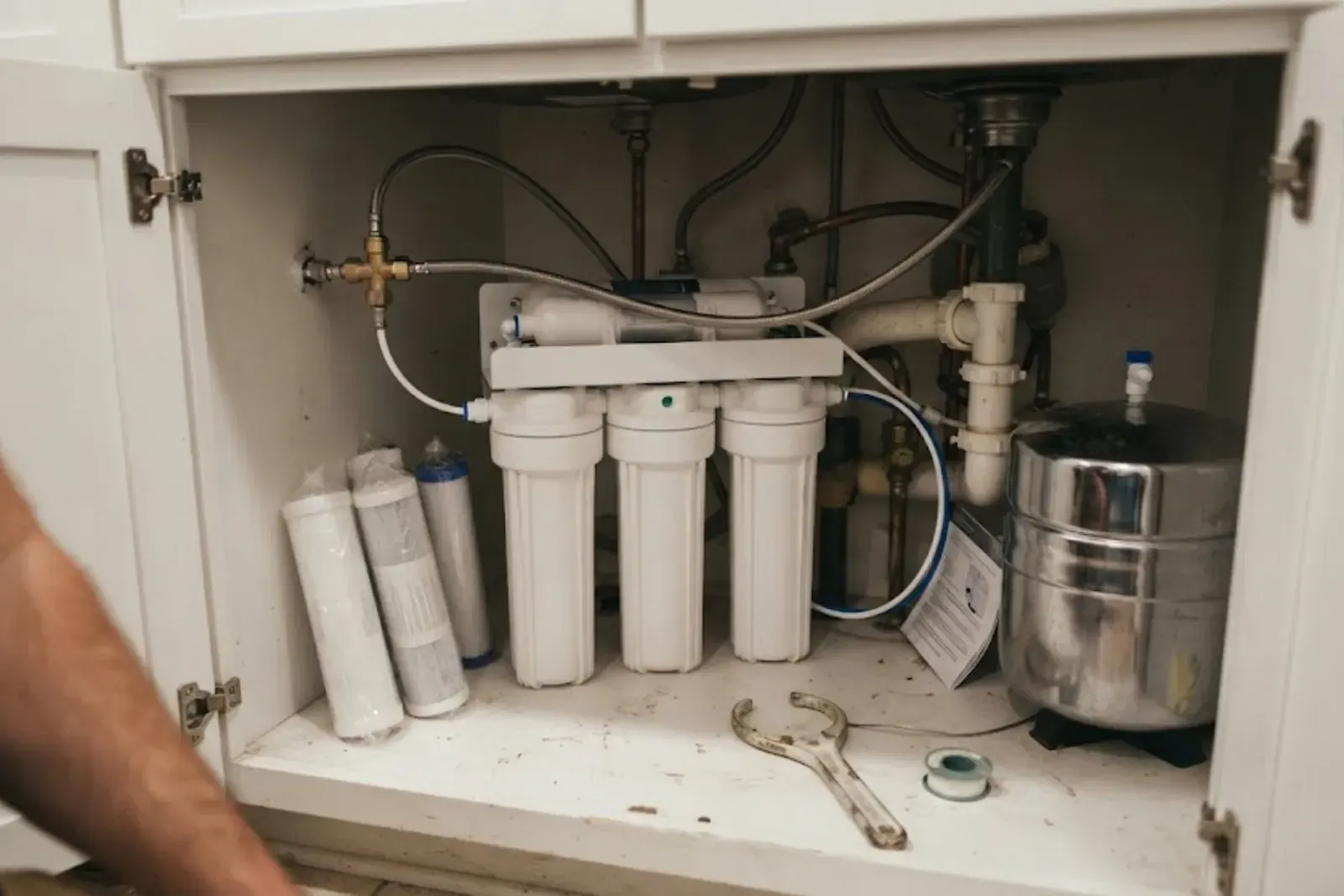
Which system does which job
Start with the problem you see, then match it to a type.
| Type | What it does | Where it goes |
|---|---|---|
| Sediment filter | Catches grit and rust flakes | Whole house or before other filters |
| Carbon filter | Reduces chlorine taste and odor | Whole house or at one tap |
| Reverse osmosis | Pushes water through a fine membrane | Under a sink, drinking tap |
| Water softener | Swaps hardness minerals for sodium or potassium | Whole house, at the main line |
| Salt-free conditioner | Changes how scale forms | Whole house |
| UV system | Treats microbes with ultraviolet light | Whole house, after filtration |
Many homes use two or three of these in sequence.
Most homes pick one or two of these, not all six. Start with what you see or taste, test the water, then add one stage at a time.
Sediment and carbon: the first line
A sediment filter is a pleated or spun cartridge with a micron rating. A lower number catches finer particles but clogs sooner. It protects other equipment and fixtures from sand and rust bits.
Carbon filters use granular activated carbon or a pressed carbon block. They mainly reduce chlorine taste and odor, and they fit either a whole-house tank or a small cartridge at the kitchen tap.
Both wear out. A clogged sediment cartridge drops water pressure, and a spent carbon cartridge stops working without any warning, so mark the replacement date on the housing.
Check the housing fits before you buy. Standard ten inch and twenty inch cartridge sizes are common, but not universal, and a wrench and a spare O-ring save a trip to the store.
Read the box: NSF/ANSI 42, 53 and 58
These are general standards that independent labs test products against. They do not tell you what is in your water.
- NSF/ANSI 42. Covers aesthetic effects such as taste and odor.
- NSF/ANSI 53. Covers reduction claims for specific contaminants listed on the label.
- NSF/ANSI 58. Covers reverse osmosis drinking water systems.
- Read the listing. A product may meet a standard only for certain listed items. Check which ones.
We do not diagnose health effects of water. For health questions, ask your physician, and use a certified lab for contaminant testing.
Reverse osmosis, softeners and conditioners
A reverse osmosis system sends water through a fine membrane at a single tap. It usually has a pre-filter, a membrane, a storage tank and a small drain line that carries away reject water. It is a drinking-water tool, not a whole-house one.
Softener versus conditioner
A softener uses ion-exchange resin to trade hardness minerals for sodium or potassium. It recharges with brine and sends the waste to a drain. A salt-free conditioner does not remove hardness. It changes how scale forms, and results vary, so ask for independent test data.
Neighbors in Bixby and Sapulpa ask about both. A plumber handling water softener and filtration can talk through each one, including where the drain line and bypass valve go.
Softeners also need salt and floor space, and the regeneration cycle sends brine to the drain. Some homeowners dislike the added sodium in drinking water, so a separate drinking tap or an RO unit is a common pairing. Ask your physician if sodium intake is a concern for you.
UV lamps
A UV unit needs clear water, so it sits after a sediment filter. It treats microbes but does not remove minerals or chemicals. The lamp needs replacing on a schedule and the system needs power.
UV works best as the last stage in a chain. Do not buy it to fix hard water, taste or sediment, since it does none of those.
Jenks, Oklahoma: what your tap water does
Jenks buys its water from the City of Tulsa, and the City of Jenks says it is treated at Tulsa's A.B. Jewell plant. The City of Tulsa publishes an average hardness of about 8.2 grains per gallon for that plant, about 140 parts per million, which the USGS would call hard. The Jenks water quality report does not list hardness, so confirm with the city or a test kit.
That number matters because hardness leaves scale on water heater elements, faucets and shower glass. A softener targets hardness, while a carbon filter does not. If you live in Sapulpa, remember that the city runs its own treatment and its report also lists no hardness, so test your own tap.
Whole-house or point-of-use
Where the filter sits matters as much as what it is.
Whole-house
Treats every tap and appliance. Costs more, but protects the water heater from scale if it is a softener.
Under-sink
Treats one tap, usually for drinking. Smaller and simpler.
Pitcher or faucet
No plumbing needed, but cartridges need regular swaps.
Shower head
Narrow job, mostly chlorine, with limited capacity.
For plumbed-in work, a plumbing installation visit can place the bypass valves and drain correctly.
Questions about water filtration
Sediment, carbon, reverse osmosis, softeners and conditioners, and UV. Each does a different job.
A softener handles hardness and scale. A filter handles grit, taste and odor. Many homes need both.
No. A conditioner changes how scale forms and does not remove the minerals, so results differ from a softener.
We do not make health claims. Ask your physician about health questions, and use a certified lab for water testing.
The City of Tulsa publishes about 8.2 grains per gallon for the Jewell plant that supplies Jenks. The Jenks report lists no hardness, so a test kit confirms it at your tap.
Unsure which type fits? A licensed plumber is on the 24/7 line. Call (855) 575-2890