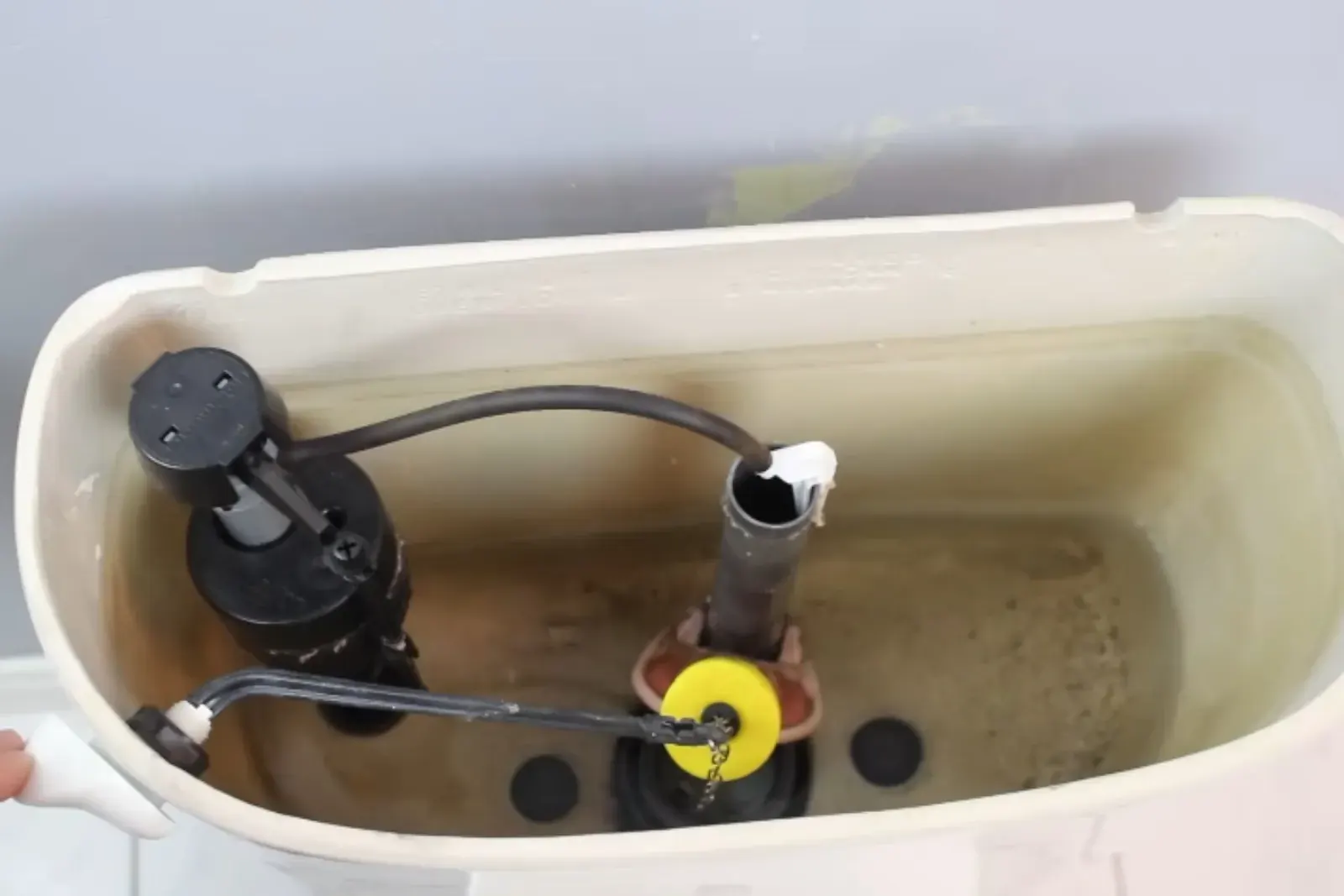
Find the leak in four checks
Take the lid off the tank and look before replacing anything.
Dye test the flapper
Drop a few drops of food coloring into the tank and wait 15 minutes without flushing. If color shows up in the bowl, the flapper is leaking.
Check the chain
The chain between the handle arm and flapper needs a little slack, about half an inch. Too tight holds the flapper open, and too loose lets it not lift fully.
Look at the water level
Water should stop about an inch below the top of the overflow tube. If it spills into the tube, the fill valve or float is set too high.
Listen to the fill valve
A hissing or a trickle after the tank is full means the fill valve is not shutting off. Replacing one takes about half an hour and a standard kit.
Symptom to part to fix
Most running toilets trace to one of five parts.
| What you see or hear | Part to check | Usual fix |
|---|---|---|
| Tank refills every few minutes with no flush | Flapper or flush valve seat | New flapper, clean the seat |
| Water spilling into the overflow tube | Fill valve or float height | Lower the float, replace the valve |
| Handle sticks, toilet runs until jiggled | Chain too tight or tangled | Adjust chain length |
| Hissing after the tank is full | Fill valve | Replace the fill valve |
| Weak flush, slow bowl refill | Clogged rim jets or low tank level | Clean jets, reset water level |
| Gurgling when other fixtures run | Vent or drain issue | Plumber checks the line |
What each part does, and why it fails
Knowing what the parts do makes the check faster. A modern low-flow toilet uses roughly 1.28 to 1.6 gallons per flush, and the tank empties through the flush valve when the handle lifts the flapper.
Flapper and chain
The flapper is a rubber seal that covers the flush valve opening. Over time it warps, hardens or collects mineral deposits, and water slips past it. The chain connects it to the handle arm, and a chain caught under the flapper keeps it open.
Fill valve and float
The fill valve refills the tank and the float tells it when to stop. A worn valve or a float arm set too high lets water keep flowing into the overflow tube, which sends it straight down the drain. Replacing the valve is a common DIY job with a fill valve kit and a pair of pliers.
Phantom flush and weak flush
A phantom flush is the toilet refilling on its own with no one touching it. It means water slowly leaks from the tank into the bowl past the flapper, then the fill valve tops it up. A weak flush has different causes: clogged rim jets, a low tank water level, or a partial clog in the trap or vent.
Jenks, Oklahoma: the water bill angle
The City of Jenks says household water use on its Home Water Usage sheet includes leaks from piping, toilets and fixtures, and the city publishes rates charged by volume per 1,000 gallons. Check the current rate card on the city site, because a toilet that runs steadily can pass a large amount of water a day without making any sound.
Jenks is also replacing about 7,600 older water meters with smart meters, per a city fact sheet, which makes it easier to spot a steady overnight draw. If the meter keeps moving with every tap closed, close the toilet supply valve and watch again. Neighbors in Bixby and Glenpool can use the same overnight test with their own meters.
Replacing a flapper or fill valve
Turn off the supply valve, flush, and sponge out the last water in the tank. Unhook the old flapper from its ears or the chain, press the new one on, and match the chain slack. Take the old part to the hardware store to match the size, since two-inch and three-inch flush valves use different flappers.
For a fill valve, unscrew the supply line from the bottom of the tank and the large locknut under it, then lift the old valve out. Set the new one to the same height, tighten the locknut by hand plus a quarter turn, and reconnect the supply. Open the valve slowly, check the connections for drips, and set the float so the water stops about an inch below the overflow tube.
Fix it yourself or call
Most running toilets are fixable with a small kit, but some are not.
DIY works
A new flapper or fill valve costs little and takes less than an hour. Shut the supply valve, flush to drain the tank, and swap the part.
Stop at the shutoff
If the supply valve will not close or drips at the stem, the repair needs a plumber. Forcing it can break the valve.
Call for leaks at the base
Water around the base is a failed wax ring or cracked bowl, not a flapper. See toilet repair.
Call for a persistent weak flush
If cleaning the jets and resetting the level does not help, the problem may be in the drain or vent line. A drain cleaning visit can find it.
Running toilet questions
A worn flapper or a stuck chain keeps the flush valve from sealing. Water leaks into the bowl and the fill valve keeps refilling.
A silent leak can pass many gallons a day, more than most people expect. Do a dye test to confirm.
It is the toilet refilling by itself, caused by a slow leak from the tank into the bowl.
Clogged rim jets, a low tank water level or a partial clog or vent problem. Clean the jets with a wire and reset the fill height.
The City of Jenks bills water by volume per 1,000 gallons per its published rates, so a running toilet counts like any other use. Ask the city about leak adjustments, because we cannot confirm a policy.
A running toilet that will not stop can be fixed fast. Call our 24/7 line. Call (855) 575-2890