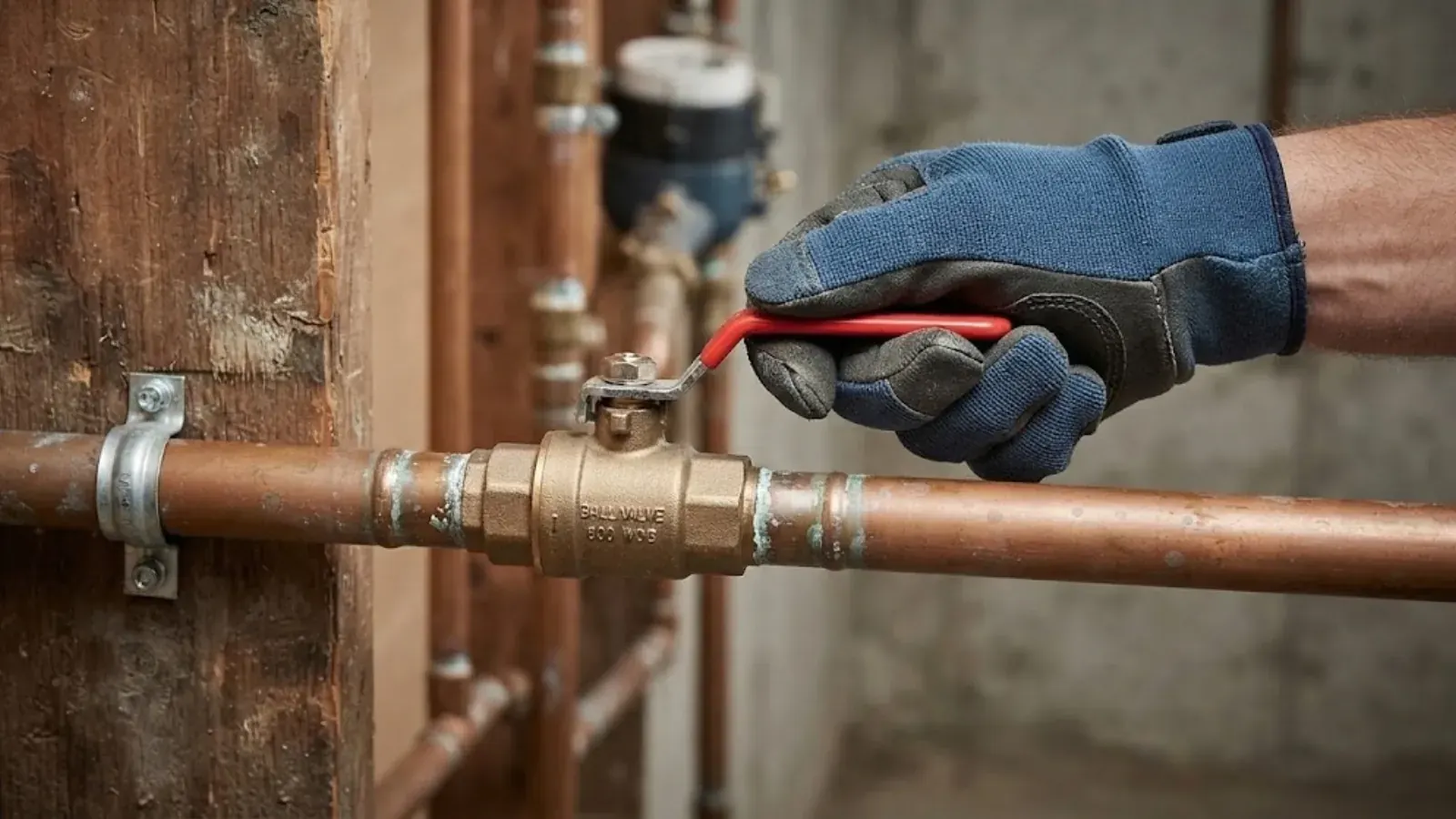
Where to look for the main shutoff
Turn the valve clockwise to close it, the same as a faucet. The main is the first valve after the water enters your home, so look where the supply line comes through the foundation or wall.
- Near the water heater or utility room. Many homes put it along the wall where the line enters, often within a few feet of the tank.
- In the garage on the street-facing wall. Look at knee to chest height for a lever or round handle.
- In a crawl space or basement. Follow the cold-water line back from the water heater to the wall.
- Outside in a box near the foundation. A small plastic lid on the side of the house can hide a valve.
- At the meter box near the street. There may be a valve on each side of the meter. Read the next sections before touching either one.
Gate valve versus ball valve
The handle tells you which kind you have. Knowing the type tells you how hard to push and whether it will survive being turned.
Gate valve (round wheel handle)
- Turns several full rotations to close.
- Wheel handle, like an outdoor spigot.
- Common in older installs and prone to sticking.
- Stems and packing can leak after years unused.
- Do not force it past firm resistance.
Ball valve (straight lever)
- Quarter turn from open to closed.
- Lever parallel to the pipe means open, across means closed.
- Common in newer builds and easier to check.
- Seals tightly and holds up well to regular use.
- If the lever binds, stop and call.
A third type, the curb stop, sits underground near the street at the end of the service line. It is usually operated with a special key and is not a homeowner valve.
The meter valve belongs to the utility
Water meters are owned by the utility, and so is the valve on the street side of the meter. In Jenks, call the City of Jenks Water Department at 918-299-5363 before you touch a meter-side valve. Turning it without asking can damage utility equipment and leave the utility without a way to control your service.
Your own main shutoff is on your side of the meter, inside the house or on the house side of the box. If you cannot find a house-side valve, ask the Water Department whether a homeowner-operated valve is present. A plumber can also install one if your home lacks it, which is part of plumbing installation work.
Which valve controls what
Keep this list taped near the water heater so anyone in the house can use it.
| Valve | What it shuts off | Who operates it |
|---|---|---|
| Main shutoff | All water to the house | Homeowner |
| Fixture stop (under sink) | One sink or toilet | Homeowner |
| Water heater cold inlet | Water to the tank | Homeowner |
| Hose bib or sprinkler shutoff | Outdoor lines | Homeowner |
| Meter-side valve | Service at the meter | Utility |
| Curb stop | The service line at the street | Utility |
Jenks, Oklahoma: winter makes this urgent
The National Weather Service Tulsa normals for 1991 to 2020 show about 72 days a year at or below freezing, and a January average low of 28 degrees. That is a long enough stretch that you should know your valve before December, not during a burst. The City of Tulsa logged 450 water line breaks between February 8 and March 4, 2021, according to news reports, and a hard freeze like that is exactly when a shutoff has to work.
The City of Jenks also publishes a line for city main breaks, 918-299-9511, and after hours the Jenks Police non-emergency number, 918-299-6311. Use these if water is coming from the street or the public side of the meter, since the main on your side of the meter is the only one you can close.
If the valve will not turn
Never force a valve with a pipe wrench or a long cheater bar. A stuck gate valve can snap its stem and leave you with no shutoff at all.
Try a firm, steady turn
Use both hands and push slowly, then back off. Do not hammer or jerk the handle.
Shut the fixture stops
If a single fixture is leaking, close the stop under that sink or toilet and keep the rest of the house running.
Reduce pressure
Open the lowest and highest taps to drain water from the lines, and turn off the water heater if the flow is on the hot side.
Call a plumber
A broken or seized main needs replacement. A licensed plumber can swap a worn gate valve for a ball valve, a common fix handled in burst pipe repair visits after a failure.
Test the valve once a year
Close the main fully, open a tap to confirm the water stops, then reopen the main slowly. This clears mineral buildup and tells you the valve still works. Do it on a calm weekend so a failure is a small problem.
If your home is in Bixby or Sapulpa, your water utility may not be the City of Jenks. Ask that utility who owns the street-side valve before you touch it.
Fixture stops deserve the same test. Turn each one closed and open again, and replace any that drip at the stem or will not move. Old multi-turn stops often seize, and swapping them for quarter-turn stops is a short job for a plumber.
After any shutoff, open a faucet to relieve pressure and bleed air from the lines. Run the cold taps first, then the hot, until the sputtering stops. If water comes out brown, let it run a minute and check that it clears.
Questions about shutting off the water
Clockwise closes a wheel valve. On a lever valve, turn the handle a quarter turn until it sits across the pipe.
Not without asking first. The meter and its valve belong to the utility, so call the City of Jenks Water Department at 918-299-5363 before touching the meter-side valve.
Close the oval or round stop on the supply line under the fixture. Turn it clockwise until it stops.
It is a sensible habit for longer trips. Also turn off the water heater, or set it to vacation mode.
For a break on the city side, call the city line at 918-299-9511. For a pipe inside your home, close your main and call a licensed plumber.
Valve stuck or leaking? Call and a licensed plumber can tell you what to do next. Call (855) 575-2890